Volume 3 · Edition 8 · 14 Oct 2026
THE FOUNDER'S DHARMA -"Shakuni: Recognizing The False Ally"
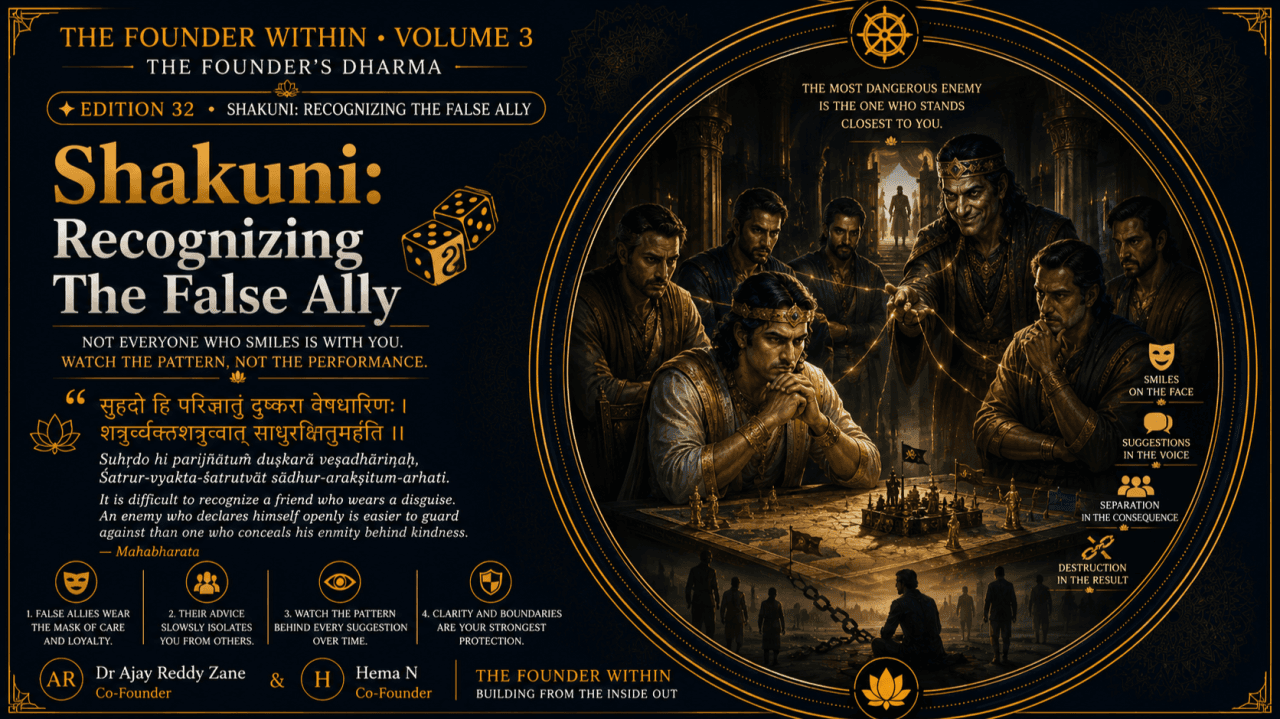
सुहृदो हि परिज्ञातुं दुष्करा वेषधारिणः। शत्रुर्व्यक्तशत्रुत्वात् साधुरक्षितुमर्हति॥
Suhṛdo hi parijñātuṁ duṣkarā veṣadhāriṇaḥ, Śatrur-vyakta-śatrutvāt sādhur-arakṣitum-arhati.
"It is difficult to recognize a friend who wears a disguise. An enemy who declares himself openly is easier to guard against than one who conceals his enmity behind kindness." — Mahabharata
The Epic Moment
Shakuni never lifted a weapon against the Pandavas. Not once, across the entire epic, did he stand before them as an open adversary.
He was Duryodhana's maternal uncle — present at family gatherings, present in the palace, present at every occasion where trust between kin is assumed rather than examined. He offered counsel. He smiled. He was, by every outward appearance, exactly what an uncle is supposed to be — a well-wisher, a steady hand, someone whose presence in the room required no explanation and invited no suspicion.
And from inside that trusted position, Shakuni did what no external army could have accomplished. He designed the rigged dice game that stripped the Pandavas of their kingdom, their dignity, and nearly their lives. He whispered continuously into Duryodhana's ear — not commands, but suggestions, framed always as loyalty, always as looking out for his nephew's interests. He shaped the entire trajectory of the Kuru dynasty's destruction from a position no one thought to question, because questioning him would have meant questioning family itself.
The Mahabharata is careful about how it portrays Shakuni. He is never crude. He is never obviously villainous in the rooms where it mattered. His danger was not that he was hard to identify as evil — his danger was that he was, in every visible way, exactly what a trusted ally looks like. Warm where warmth was expected. Present where presence built confidence. Advising in a tone that never once sounded like sabotage.
By the time his role in the family's ruin became undeniable, the damage had already compounded across years, through decisions that had each, individually, seemed reasonable at the time they were made.
The Founder Parallel
The most dangerous people in any founder's journey are rarely the obvious opponents. Competitors are easy to guard against — you know they want what you have, and that knowledge alone keeps you alert.
The genuinely dangerous ones are the people who appear to be allies. Who sit inside your inner circle, your board, your closest advisory relationships — and who use exactly that position of trust to slowly dismantle what you have built, one small, reasonable-seeming suggestion at a time.
This is what makes the Shakuni pattern so much harder to defend against than the six betrayals described earlier in this journey, or even the seven masks and four dangerous types catalogued across this book. A mask, tested properly, eventually reveals itself. A dangerous personality type, examined closely, shows a consistent pattern of extraction. But Shakuni does not extract obviously. He advises. He reframes. He nudges decisions in directions that serve his own ends while sounding, in every individual conversation, like nothing more than a trusted voice offering perspective.
The compounding damage happens exactly because no single conversation looks like betrayal. It is only when you step back — the way the epic eventually forces the reader to step back — and look at the full pattern across months or years, that the shape of what has actually happened becomes visible.
Ajay's Experience
There was a period in the Elfinity Group's growth where I began noticing something I could not immediately name.
People who had once been close to me — trusted collaborators, early community members, people I had built real relationships with — began, one at a time, drifting away. Not dramatically. Not with any single confrontation I could point to. Just a slow, steady reduction in warmth, in availability, in the quality of relationships that had once felt solid.
I did not understand the pattern until much later. There was a person, inside what I had considered my inner circle, whose counsel I had trusted specifically because it always sounded reasonable. Every suggestion they made about a specific person, a specific decision, a specific direction — always framed as looking out for my interests, always delivered with the tone of someone who wanted the best for me and for what I was building.
It was only when I finally stepped back and mapped the pattern — the way the epic eventually reveals Shakuni's full role only in hindsight — that I understood what had actually happened. Trusted people had not simply drifted away on their own. They had been, quietly and consistently, moved away — through suggestions, through subtle reframing, through counsel that always pointed, incrementally, toward isolation rather than connection.
I want to be honest that I still cannot point to a single conversation and say, definitively, that was the moment of betrayal. That is exactly the nature of this pattern. It does not offer a single moment. It offers years of individually defensible suggestions that only reveal their true shape when examined together, at scale, after the damage has already compounded.
What I learned from this — expensively, the same way I learned everything else described in this book — is that trust extended to an advisor requires the same discernment as trust extended to anyone else. Perhaps more, because the position of advisor is specifically designed to bypass the scrutiny that a stranger would naturally receive.
The Dharma Lesson
The shloka that opens this edition names the exact asymmetry that makes Shakuni more dangerous than any open enemy: an enemy who declares himself invites your guard. A friend who conceals hostility behind kindness disarms it entirely.
This is not a lesson about becoming suspicious of every advisor, every close relationship, every person who offers counsel. That overcorrection would cost you the genuine allies this book has already spent many chapters teaching you to recognize and build with — Chapter Thirteen's inner circle, earned through years of tested loyalty, honesty, sacrifice, and genuine care.
The lesson is narrower and more precise: learn to recognize the Shakuni in your ecosystem — not with suspicion, but with clarity.
Clarity means watching not just what someone says in any single conversation, but the cumulative direction their counsel consistently points toward. Does their advice, over time, tend to isolate you from other trusted people, or does it tend to strengthen your relationships? Does their framing consistently position them as your primary interpreter of situations — echoing the Calculated Manipulator pattern from Chapter Seven — or does it genuinely make room for other voices?
Not everyone who smiles is with you. Some of the most costly damage in any founder's journey comes not from people who declared themselves enemies, but from people who never had to, because they were never suspected of needing to.
Watch the pattern, not the performance. The performance will always be warm. The pattern will eventually tell you the truth.
Continued in Edition 9 — Rebuilding With Dignity: How To Rise After Adharma Without Becoming It