Volume 3 · Edition 7 · 14 Oct 2026
THE FOUNDER'S DHARMA - "The Dice Game"
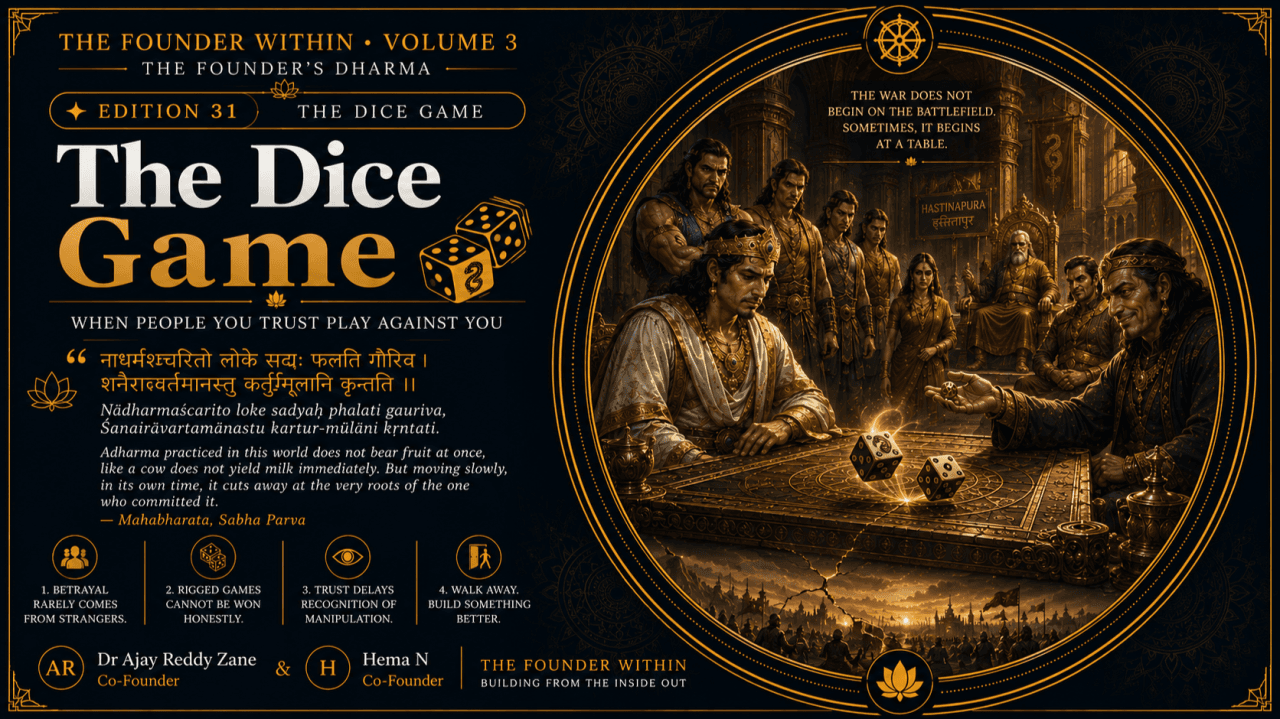
नाधर्मश्चरितो लोके सद्यः फलति गौरिव। शनैरावर्तमानस्तु कर्तुर्मूलानि कृन्तति॥
Nādharmaścarito loke sadyaḥ phalati gauriva, Śanairāvartamānastu kartur-mūlāni kṛntati.
"Adharma practiced in this world does not bear fruit at once, like a cow does not yield milk immediately. But moving slowly, in its own time, it cuts away at the very roots of the one who committed it." — Mahabharata, Sabha Parva
The Epic Moment
Hastinapura was home.
Not enemy territory. Not a rival kingdom. Hastinapura was the shared capital of the Kuru dynasty — the city both the Pandavas and the Kauravas had grown up considering their own, ruled by the same bloodline, bound by the same ancestors. When Yudhishthira received the invitation to Duryodhana's newly built sabha — a magnificent assembly hall, constructed specifically for this occasion — he had every reason to walk in without suspicion.
This was family. This was home ground. This was, by every convention of hospitality and kinship that governed that world, a safe room.
It was not.
Shakuni, Duryodhana's uncle, had spent years mastering dice specifically for this moment — dice that were, by most tellings, loaded, cursed, or otherwise rigged to obey his will rather than chance. Yudhishthira, invited to play what appeared to be a ceremonial, friendly game among family, agreed. Not out of arrogance. Out of the specific obligation a king felt toward hospitality, and the specific inability to refuse an invitation from kin without appearing to accuse them of something he could not yet prove.
The game began. And Yudhishthira began to lose.
What happened next is one of the most psychologically devastating sequences in the entire epic — not because of what was lost, but because of why the losing continued. Yudhishthira staked his wealth. He lost it. He staked his kingdom. He lost that too. He staked his brothers, one by one. He lost each of them. He staked himself. He lost himself.
And still he played on.
He was not defeated by greed, as it is sometimes told. He was defeated by disbelief. At every stage, some part of him could not accept that Shakuni — his own family, a man who had sat at their table, who had watched Yudhishthira grow from childhood — was actually cheating him. Surely the next roll would turn. Surely this was simply misfortune, not manipulation. Surely someone he trusted this completely would not do what the evidence was already showing him.
That disbelief is what allowed the game to continue long after it should have stopped. By the time Yudhishthira staked Draupadi — the final, most devastating wager — there was almost nothing left to lose, and almost no version of the truth left to deny.
The Pandavas were not defeated on a battlefield. They were defeated at a table, in a hall built for the occasion, in the city that was supposed to be their home, by people they had every reason to trust.
The Founder Parallel
Most founder betrayals do not announce themselves. They do not arrive as hostile takeovers from outside competitors, or attacks from people who were always clearly adversaries.
They happen slowly. At the table. In the room. By people who were given access, vision, and a seat in the inner circle — people who, like Shakuni, had every appearance of belonging there.
The specific danger is not the betrayal itself. It is the disbelief that delays your response to it. The same trust that allowed the relationship to form in the first place becomes the exact mechanism that prevents you from seeing it turn. You explain away the first loss. You explain away the second. Surely this person — who has sat at your table, who knows your family, who has been part of this from the early days — would not actually be doing what the pattern is already showing you.
That hesitation, born entirely from trust rather than foolishness, is what lets the damage compound. By the time the pattern becomes undeniable, the cost has often already reached the equivalent of Yudhishthira's final wager — the thing you never meant to risk at all.
Ajay's Experience
The single costliest version of this in my own journey involved a community I had built from zero.
I will not name it, and I will not name the specific person, because the details are not the point — the pattern is. This was a community built through years of consistent, patient, unglamorous work — showing up for founders before there was any reason for them to show up for me, building relationships one at a time, earning trust the slow way.
I trusted someone completely with that community. Gave him a genuine seat inside it — access to the relationships, the structure, the specific things that had taken years to build. Not because I was careless, but because he had, by every appearance, earned that seat the way anyone earns trust — through time, through presence, through what looked like genuine alignment.
And then, gradually — not in a single dramatic moment, but the way Shakuni's dice turned the game, roll by roll — that trust was used against me. The community I had built was, over time, positioned as something he had built. The story shifted, quietly, in rooms I was not present for, until the version being told was no longer accurate.
I want to be honest about something: I did not see it immediately, for the same reason Yudhishthira kept playing. I could not fully believe, at first, that someone I trusted that completely would do what the evidence was slowly beginning to show me. That disbelief cost time. It cost clarity. It cost me the version of events getting corrected before it had already spread.
When I finally saw the pattern completely — when there was no honest way left to explain it away — I made a decision that I still consider one of the most important of this entire journey. I did not fight to reclaim what had been taken. I did not spend months trying to correct a false narrative or win back a community through conflict.
I walked away. And I built something better — completely independently, from nothing, carrying none of what had been taken with me.
That walk away was not defeat. Staying to fight for what had already been compromised would have required me to become someone I did not want to be — someone who wins through conflict rather than through building. I refused that trade.
The Dharma Lesson
The shloka that opens this edition carries the exact lesson of the dice game: adharma does not strike immediately. It waits. But it always strikes.
Shakuni's cheating was adharma the moment the loaded dice were first rolled — but its consequences did not arrive that day. They arrived years later, at Kurukshetra, when the entire Kuru dynasty, including Duryodhana himself, was destroyed by the war that dice game ultimately caused. Adharma is patient. It does not need to punish immediately, because it is already, quietly, cutting away at the roots of the one who practiced it.
This is the deepest comfort this chapter offers, and also its hardest instruction. When someone you trusted plays against you — when the pattern becomes undeniable and the room reveals itself as unsafe — your dharma is not to match their adharma with adharma of your own. It is not to cheat back, to fight dishonestly, to win through the same manipulation that was used against you.
When adharma reveals itself — do not match it. Walk away and build something better.
The Pandavas did not win at the dice table. They could not have — the game was rigged from the start, and no honest strategy defeats a dishonest one played on its own terms. Their eventual victory came from something else entirely: thirteen years of rebuilding, in exile, away from that hall, away from that table, becoming something the dice game could never have produced.
That is your dharma too, when the people you trusted play against you.
Not to win the rigged game. To walk away from the table, and build something the table could never have given you.
Continued in Edition 8 — Shakuni: Recognizing The False Ally