Volume 3 · Edition 6 · 14 Oct 2026
THE FOUNDER'S DHARMA - The Helper Wound
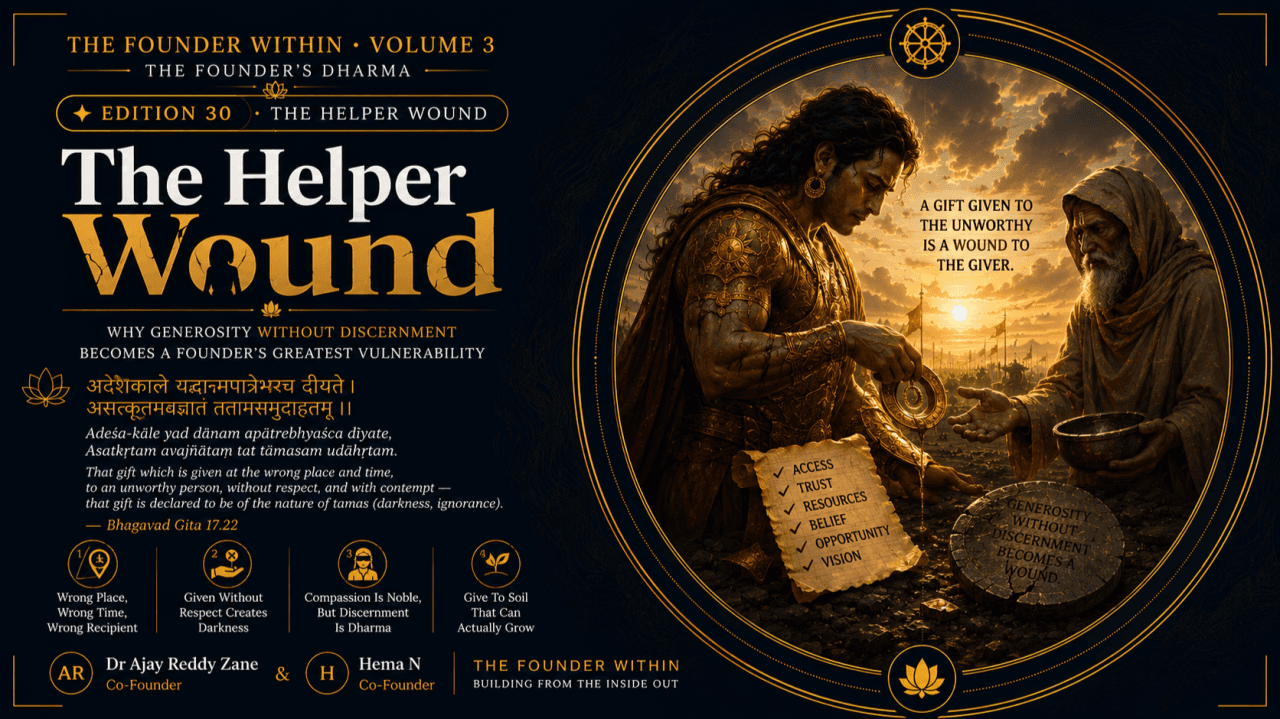
अदेशकाले यद्दानमपात्रेभ्यश्च दीयते। असत्कृतमवज्ञातं तत्तामसमुदाहृतम्॥
Adeśa-kāle yad dānam apātrebhyaśca dīyate, Asatkṛtam avajñātaṁ tat tāmasam udāhṛtam.
"That gift which is given at the wrong place and time, to an unworthy person, without respect, and with contempt — that gift is declared to be of the nature of tamas (darkness, ignorance)." — Bhagavad Gita 17.22
The Epic Moment
Krishna, teaching Arjuna about the three natures of every human action, arrives eventually at charity — at giving itself. And what he says is not what most people expect.
He does not say all giving is good. He says giving has a nature, just as action has a nature — and that nature depends entirely on who receives it, when, and why.
A gift given without regard for whether the recipient deserves it, given carelessly, given because refusing felt harder than giving — this, Krishna says, is tamasic giving. Giving in darkness. Giving that does not build, does not honor the giver or the receiver, and ultimately produces nothing of value.
No character in the Mahabharata embodies the cost of this more completely than Karna.
Karna was born with kavach and kundal — golden armor and earrings fused to his own skin at birth, making him nearly unbeatable in battle. He was, by every measure the epic gives us, the most talented warrior alive — faster than Arjuna, stronger than most of the Kauravas combined. A single man who could have altered the outcome of the entire war, simply by keeping what he already possessed.
He gave almost all of it away.
Karna had made a vow early in his life: he would never refuse anyone who came to him asking for something, if it was in his power to give. Indra, king of the gods, knew this. Indra also knew that Karna's armor made him unbeatable against his own son, Arjuna. So Indra disguised himself as a poor Brahmin and approached Karna, asking for the kavach and kundal as alms.
Karna knew — the text tells us he knew — that this Brahmin was not what he appeared to be. He suspected, correctly, that this was a trick designed to weaken him before the war. He gave the armor away anyway. Peeled it from his own skin. Because a vow, once made, was not something he would break — even understanding, completely, what it would cost him.
He did not die because Arjuna was more skilled. He died, in significant part, because he had already given away the thing that made him equal to Arjuna — to someone who came asking, undeserving, disguised, simply because Karna could not separate the vow to give from the wisdom of who to give it to.
His talent did not destroy him. His enemies did not destroy him.
His own generosity — given without discernment — destroyed him.
The Founder Parallel
Every founder who has been betrayed has a Karna moment.
Not a moment of stupidity. A moment of genuine, uncalculated giving — access extended, trust placed, vision shared, opportunity handed to someone — before that person had actually earned any of it.
This is not a failure of intelligence. Karna was not unintelligent. He suspected the disguise. He understood the risk. He gave anyway, because somewhere along the way, his identity had fused completely with the act of giving — and refusing anyone, deserving or not, had become indistinguishable, in his own mind, from betraying who he was.
That fusion is the actual danger this chapter is about. Not generosity itself. The moment generosity stops being a deliberate choice, made freshly each time, and becomes an identity that cannot say no.
Every founder who has ever handed a stranger the keys to something they spent years building — because refusing felt like it would betray their own values — is living a version of Karna's exact tragedy.
Ajay's Experience
Six people.
A partner. A collaborator. A trusted team member. A community leader. A co-founder candidate. And two who came as supporters.
Each one received something real from me — access, trust, resources, belief — before they had done anything to earn it. And each one returned something that cost me deeply, across six separate seasons of building.
I understand now where the underlying vow came from. I watched my father, for years, absorb exploitation from his own brothers without complaint — his labor taken, never repaid, never even acknowledged. Something in me formed early, long before I understood I was forming it: I will not be the kind of person who refuses someone in need. I will give what my father was never given.
That vow, carried without discernment, cost me exactly what it cost Karna. Not once — six times, in six different shapes, each one following the same underlying pattern. Someone asked — sincerely or with calculation, it did not matter to the vow — and I gave, because the asking itself had quietly become, for me, sufficient grounds for receiving.
I have had to learn, expensively and repeatedly across these six seasons, to separate two things that had become fused in me the same way they were fused in Karna: the vow to help, and the discernment about who has actually earned that help.
Compassion, I now understand, should always be available to anyone. Access should always be earned. They are not the same thing. Conflating them is precisely what cost me, six separate times, what should never have been so easily given away.
The Dharma Lesson
Karna's story is usually told as a story about misplaced loyalty — his devotion to Duryodhana, sustained even when Duryodhana stood clearly on the wrong side of dharma.
But underneath the loyalty is something even more universal, and more relevant to every founder reading this: the specific danger of a generosity that has become identity rather than deliberate, renewed choice.
Krishna's teaching is precise about this. Not all giving is good. Giving without regard to time, place, or the worthiness of the recipient — giving simply because refusing felt harder — is tamasic. It does not honor the giver, and it does not build the receiver. It is, in Krishna's own words, given "without respect, and with contempt" — not contempt in feeling, but contempt in carelessness, in the failure to actually see who stands in front of you before handing them what you have spent years earning.
Generosity without discernment is not a virtue. It is a wound waiting to happen.
Give fully — that instinct is not the problem. It may be one of the best things about you, exactly as it was one of the best things about Karna. But give wisely. Ask, before you hand over what took years to build, whether the person in front of you has actually earned it, or whether they have simply asked convincingly enough that refusing felt harder than giving.
The world will always send someone, disguised as deserving, to test whether you have learned the difference.
A gift given to an unworthy person is wasted like seed sown on barren soil. Give what you have — but give it to soil that can actually grow something.
Continued in Edition 7 — The Dice Game: When People You Trust Play Against You