Volume 3 · Edition 5 · 14 Oct 2026
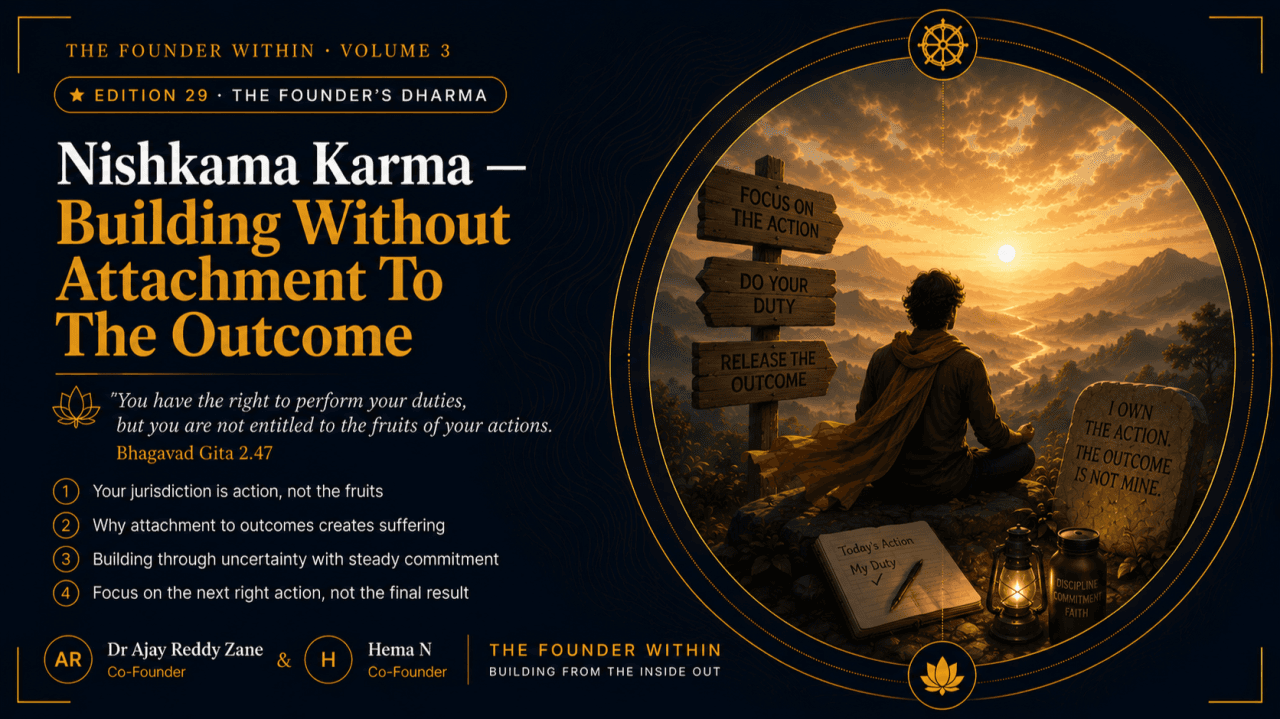
THE FOUNDER'S DHARMA - Nishkama Karma — Building Without Attachment To The Outcome
कर्मण्येवाधिकारस्ते मा फलेषु कदाचन। मा कर्मफलहेतुर्भूर्मा ते सङ्गोऽस्त्वकर्मणि॥
Karmaṇy-evādhikāras te mā phaleṣu kadācana, mā karma-phala-hetur bhūr mā te saṅgo 'stv akarmaṇi.
"You have the right to perform your duties but you are not entitled to the fruits of your actions. Never consider yourself the cause of the results of your activities, and never be attached to not doing your duty." — Bhagavad Gita 2.47
The Epic Moment
This is the verse most people know.
Even people who have never read the Gita have encountered this verse — in some form, in some context, quoted by a parent or a teacher or a motivational speaker who may or may not have understood what it actually means.
And because it is so widely quoted — and so frequently misquoted — it is worth being precise about what Krishna is actually saying here. Because what he is saying is considerably more demanding than most popular interpretations suggest.
He is not saying — do your best and don't worry about the outcome.
He is not saying — work hard and let go.
He is not offering a spiritual coping mechanism for people who tried their best and fell short.
He is saying something far more precise and far more uncomfortable:
Your jurisdiction is action. Outcomes are not yours.
Not — outcomes are not always yours. Not — outcomes are mostly not yours.
Outcomes are not yours. Full stop.
The action is yours — completely and without reservation. You are responsible for the quality of your work, the integrity of your effort, the consistency of your showing up. That is fully within your domain and fully your responsibility.
But the fruit of that action — the result, the recognition, the revenue, the validation, the success, the proof that it was worth it — that is not within your domain. It never was. The belief that it was yours to control was always the illusion.
This is not a comfortable teaching. It is not meant to be.
Because the moment you genuinely internalize it — not as a concept but as a way of operating — it removes something that most high-performing people use as fuel.
The attachment to outcome.
The belief that the result is coming — that the validation is around the corner, that the work will eventually be recognized, that the sacrifice will eventually be rewarded — is one of the most powerful drivers of human effort. And Krishna is saying: release it. Not because it is wrong to want good outcomes. But because the attachment to outcomes is precisely what makes sustained action impossible when the outcomes don't arrive on schedule.
The founder who is attached to the outcome of each action cannot sustain action when outcomes disappoint — which, in building, they regularly do.
The founder who acts without attachment to outcome continues building regardless — because the building itself is the point.
The Founder Parallel
There is a specific kind of exhaustion that has nothing to do with how much work you are doing.
It is the exhaustion of waiting for the result to justify the effort.
Every founder who has been through a difficult season recognizes it. The product is built. The outreach is happening. The events are running. The newsletter is going out. The community is growing — slowly, honestly, without shortcuts. And every day, the gap between the effort being expended and the tangible result being produced feels like a judgment on whether the whole thing is worth it.
That gap — between action and visible outcome — is where most founders break.
Not because the work is too hard. The work is often genuinely hard, but most founders who reach this point have already proven they can do hard work.
They break because the outcome is not arriving fast enough to justify the effort — and without the outcome as fuel, they cannot find a reason to keep going.
This is the trap that nishkama karma is designed to address.
Not by making the outcomes less important. Outcomes matter. Revenue matters. Growth matters. Validation matters.
But by relocating the source of fuel for action from the outcome — which is outside your control and chronically unreliable as a motivator — to the action itself, which is always within your control and always available as a source of direction.
The founder who builds from nishkama karma does not work harder than the attached founder. They often work the same number of hours, with the same intensity, toward the same goals.
But they are not powered by the outcome. They are powered by the action.
And because their fuel source is internal rather than external — it does not run out when the outcomes disappoint. It is simply replenished by the next right action.
This is not a spiritual abstraction. It is an operational advantage.
The nishkama karma founder can sustain effort through longer periods of invisible progress than the outcome-attached founder — because they are not measuring the effort against the result at every turn. They are simply doing the next right thing.
And in building — where the distance between sustained effort and visible result is often measured in years rather than weeks — that operational advantage compounds dramatically over time.
Ajay's Experience
I want to tell you about a specific kind of day that happened regularly in the early years — and still happens, less frequently but genuinely, now.
The day where you do everything right and nothing visibly changes.
The event is planned and executed well. The newsletter goes out and the open rate is good. The community engagement is genuine and growing. The conversations with potential partners are promising. And at the end of that day — the revenue is the same as yesterday, the team is the same size, the scale is unchanged.
On those days, the outcome-attached mind has a very specific experience. It begins to calculate. How long can this continue before it proves the whole thing was a mistake? How many more days of right action without visible result before the rational conclusion is to stop?
I have had that calculation run in my mind more times than I can count.
And what I have learned — through eight years of that calculation running and choosing to continue anyway — is that the calculation is asking the wrong question.
The right question is not — how long before the outcome justifies the effort?
The right question is — is this the right action for today?
That is the only question nishkama karma asks. And it is the only question that can be answered with certainty. The outcome cannot be answered with certainty. The timeline cannot be answered with certainty. Whether it will eventually work cannot be answered with certainty.
But whether this — the next right action — is the right thing to do today? That can almost always be answered.
And when the answer is yes — which it almost always is, if you are building something real for the right reasons — you do it. Without calculating what it will produce. Without measuring it against the gap between where you are and where you need to be.
You simply do the work.
This is not passivity. It is not resignation. It is not giving up on outcomes.
It is the most active, most engaged, most fully committed form of building — precisely because it does not depend on the outcome to sustain it.
I built the Elfinity Group through years where the outcomes were not arriving on the timeline I had imagined when I made the oath on that train. The community grew — but slowly. The events worked — but not immediately. The recognition came — but not before I had questioned, many times, whether it was coming at all.
What kept me building through those years was not confidence that it would work.
It was the practice — imperfect, inconsistent, but genuine — of doing the next right thing regardless of whether the previous right thing had produced a visible result.
That practice is what nishkama karma looks like in a startup.
Not enlightenment. Not detachment from caring about the outcome.
Just the daily discipline of separating the question of what to do — which you can answer — from the question of what it will produce — which you cannot.
The Dharma Lesson
Krishna gives this verse early in the Gita — in the second chapter, before most of the philosophical framework has been laid out.
That placement is deliberate.
Before Arjuna can understand anything else Krishna is about to tell him — about the self, about dharma, about the nature of action and consequence — he needs to understand this.
Your jurisdiction is action. Outcomes are not yours.
Not as a consolation for failure. As a prerequisite for sustained effort.
Because the founder who has released attachment to outcome can do something that the attached founder structurally cannot:
They can keep building indefinitely — through the years when the outcomes are not visible, through the seasons when the external world is not confirming that the internal conviction is right, through the long wilderness periods where the only evidence that the effort matters is the effort itself.
That capacity — to sustain action through sustained uncertainty — is the single most important quality in the founder's journey.
Not talent. Not intelligence. Not network or timing or market insight.
The capacity to keep building when the building is not yet producing visible proof that it should continue.
And that capacity is only available to the founder who has genuinely — not theoretically, not aspirationally, but actually — released their grip on the outcome.
Do the work because it is your dharma.
Not because of what it will give you.
Not because of when it will prove itself.
Because it is the right action — today, in this moment, with what you have.
That is the only jurisdiction you have ever actually had.
Exercise it completely. And release the rest.
Continued in Chapter Six — The Helper Wound: What Happens When You Give Too Much To The Wrong People