Volume 3 · Edition 2 · 14 Oct 2026
THE FOUNDER'S DHARMA — "The Oath That Changes Everything"
नष्टो मोहः स्मृतिर्लब्धा त्वत्प्रसादान्मयाच्युत। स्थितोऽस्मि गतसन्देहः करिष्ये वचनं तव॥
Naṣṭo mohaḥ smṛtir labdhā tvat-prasādān mayācyuta, sthito'smi gata-sandehaḥ kariṣye vacanaṁ tava.
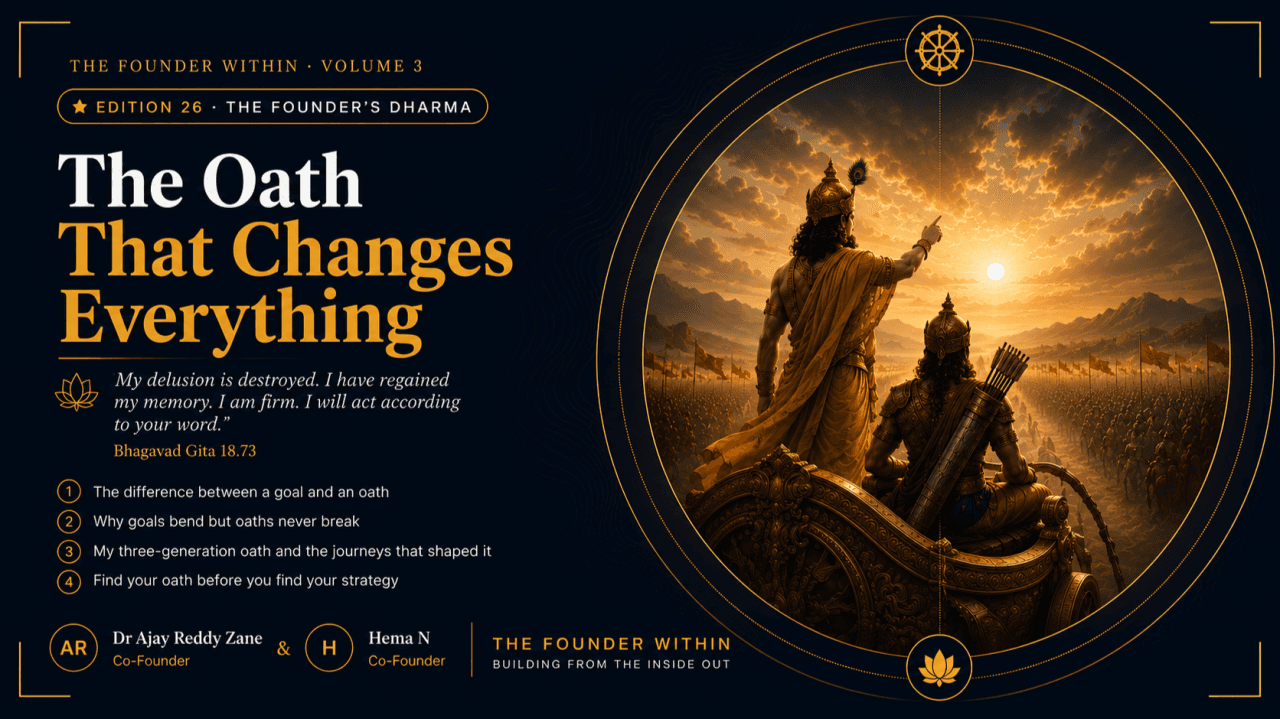
"My delusion is destroyed. I have regained my memory. I am firm. I will act according to your word." — Bhagavad Gita 18.73
The Epic Moment
The Bhagavad Gita spans eighteen chapters.
Eighteen chapters of the most studied philosophical dialogue ever recorded — covering dharma, action, devotion, knowledge, the nature of the self, the nature of God, and the nature of everything that exists between them.
And at the end of all eighteen chapters — after Krishna has said everything that needed to be said — Arjuna speaks.
Not with a battle cry. Not with a warrior's declaration.
With something far simpler. And far more powerful.
"My delusion is destroyed. I have regained my memory. I am firm. I will act according to your word."
Four lines. After eighteen chapters.
That is the moment the Geeta was always building toward.
Not the philosophy. Not the wisdom. Not the most famous verses that scholars quote and temples inscribe on their walls.
This moment.
This single turning point where a man who had lost himself — who had sat down in his own chariot and let his bow slip from his hand — stands up again.
Not because the battlefield changed. Not because the enemies became fewer. Not because the consequences became lighter.
But because something inside him had shifted permanently.
His delusion was destroyed. His clarity had returned. His conviction was firm.
And from that firmness — from that internal oath — everything that followed became possible.
The Founder Parallel
There is a difference between a goal and an oath.
Most founders begin with goals.
Revenue targets. User numbers. Funding milestones. Market share. Five-year plans with quarterly breakdowns and color-coded dashboards tracking progress toward destinations they chose on a good day and must now justify on every bad one.
Goals are useful. Goals give direction. Goals create accountability.
But goals can be changed.
Goals can be renegotiated when the market shifts, when the team shrinks, when the investor meeting goes wrong, when the product doesn't work the way the pitch said it would.
Goals bend under pressure.
An oath does not.
An oath is not a target. It is not a milestone. It is not a KPI on a dashboard.
An oath is a statement of who you are — not what you want to achieve.
And that distinction is everything.
Because on the days when the goals feel impossible — when the revenue isn't coming, when the team is falling apart, when the people you trusted have taken what they came for and left — the goals offer no real reason to continue.
They are just numbers that haven't been hit yet.
But an oath?
An oath reaches into the part of you that exists before the startup. Before the pitch deck. Before the first hire and the first customer and the first failure.
An oath says — this is not about what I am building. This is about who I am.
And who you are does not change because the quarter went badly.
The founders who last are not the ones with the best goals. They are the ones with the deepest oaths.
Ajay's Experience
I did not arrive at my oath through wisdom.
I arrived at it through observation.
Those long train journeys between my village and Vijayawada — twelve hours, sometimes fourteen — gave me something that no classroom ever did. They gave me time to watch people without agenda. Without pretense. Without any reason to see anything other than what was actually there.
And what I saw, again and again, on those journeys, was this:
People who had worked their entire lives — and were still working. Still carrying the same weight at fifty that they had carried at twenty-five. Still worried about the same things. Still unable to rest.
Not because they were failures. Many of them were, by every conventional measure, successes.
They had jobs. Salaries. Houses. Children in good schools. Respect in their communities.
And yet something was missing. Not in their lives exactly — but in the shape of their lives. As though all that effort had led somewhere real, but not somewhere free.
I watched that and felt something I could not yet name.
What I know now is that it was grief — a quiet, pre-emptive grief for a future I could see forming around me if I made the expected choices.
And from that grief, slowly, over many journeys, something else formed.
Not a plan. Not a strategy. Not a business model.
An oath.
Three generations — including my own — must be settled through whatever I build from this day forward.
I want to be precise about what that oath actually meant when I made it.
It did not mean I was certain of success. I was not. It did not mean I had a path. I did not. It did not mean I was fearless. I was terrified.
What it meant was this — the outcome of my life would no longer be determined by the expectations built around me.
It would be determined by what I was willing to become.
That oath was made quietly. On a train. To no one but myself.
I have not broken it once in eight years.
Not when the team collapsed. Not when the people I trusted took what they came for and disappeared. Not when the money ran out and the debts mounted and the path ahead was completely invisible.
The oath was never tested by success.
It was tested by failure. By betrayal. By loneliness. By the specific humiliation of building something real and watching someone else claim it as theirs.
And every time — it held.
Not because I am extraordinary.
But because an oath, made from the right place, for the right reason, is stronger than any obstacle that tests it.
That is what I learned.
That is what Arjuna learned.
That is what every founder who has ever stood up after being knocked down — and kept building — already knows somewhere inside themselves.
The Dharma Lesson
Krishna did not give Arjuna a strategy at Kurukshetra.
He gave him clarity.
And from that clarity — Arjuna made an oath.
I am firm. I will act.
Not — I will try. Not — I will see what happens. Not — I will pursue this goal until circumstances change.
I am firm. I will act.
That is the difference between a founder who lasts and one who stops.
Not talent. Not funding. Not market timing. Not the quality of the idea.
The oath they made before they started — and whether they made one at all.
Here is what I want every founder reading this to carry away from Edition 26:
Before you build your startup — find your oath.
Not your goal. Not your mission statement. Not your vision slide.
Your oath.
The statement that cannot be negotiated when everything around you is falling apart.
The conviction that holds when the goals no longer feel achievable.
The reason that exists before the strategy — and outlasts every version of it.
Because goals give you direction.
But an oath gives you the thing direction alone can never give you.
It gives you the reason to keep going when the direction disappears.
A goal can be abandoned. An oath cannot.
Find your oath before you find your strategy.
Continued in Edition 3 — Why You Were Born For This | THE FOUNDER'S DHARMA