Volume 3 · Edition 15 · 14 Oct 2026
THE FOUNDER'S DHARMA - "The Geeta Was Given On A Battlefield" Wisdom Arrives In Pressure, Not Comfort
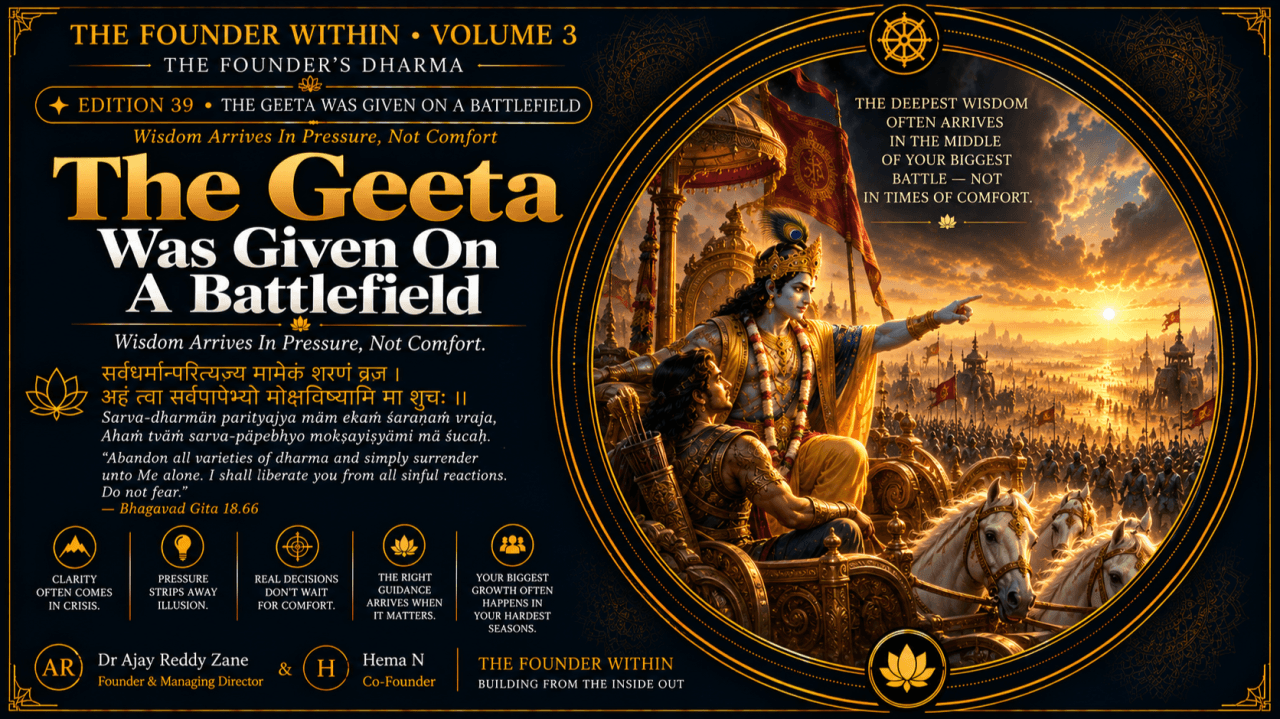
सर्वधर्मान्परित्यज्य मामेकं शरणं व्रज। अहं त्वा सर्वपापेभ्यो मोक्षयिष्यामि मा शुचः॥
Sarva-dharmān parityajya mām ekaṁ śaraṇaṁ vraja, Ahaṁ tvāṁ sarva-pāpebhyo mokṣayiṣyāmi mā śucaḥ.
"Abandon all varieties of dharma and simply surrender unto Me alone. I shall liberate you from all sinful reactions. Do not fear." — Bhagavad Gita 18.66
The Epic Moment
There is a detail about the Bhagavad Gita that gets lost simply because it has become so familiar over centuries of retelling: it was never delivered anywhere resembling a place of comfort.
Not a temple. Not a forest hermitage, the traditional setting for spiritual instruction throughout Indian tradition. Not a quiet room where a teacher and student could sit undisturbed, free from the pressure of consequence, taking whatever time was needed to arrive slowly at understanding.
The most complete and most studied philosophical dialogue in human history was delivered on a battlefield. Between two armies, already assembled, already prepared to kill each other within hours. Arjuna's crisis was not a scheduled appointment for reflection — it arrived in the middle of the single highest-pressure moment of his entire life, with no possibility of postponement, no option to return home and think it over, no space to gather himself gradually before the conversation needed to happen.
Krishna does not suggest, at any point across eighteen chapters, that this is the wrong time or place for this teaching. He does not say, let us withdraw somewhere quieter and continue this later. He teaches Arjuna exactly where Arjuna is standing — in the chariot, between the armies, with the weight of the entire war pressing down on every word.
This final verse, coming at the close of the entire dialogue, is perhaps the clearest evidence of this principle. Krishna's ultimate instruction — abandon every other dharma and surrender completely, without fear — is not offered as a comfortable philosophical conclusion to be pondered at leisure. It is offered as the last thing Arjuna hears before he must act, immediately, in the specific crisis he cannot escape. The teaching and the test arrive in the same breath.
The Founder Parallel
There is a persistent and mistaken belief that clarity arrives in calm conditions — that a founder should seek quiet, distance from pressure, some retreat from the noise of building, in order to think clearly about the decisions that matter most.
The Gita suggests something closer to the opposite is usually true.
The deepest, most reliable clarity in a founder's journey rarely arrives during the comfortable seasons. It arrives, with striking consistency, in the middle of the hardest ones — on the worst days, in the most uncertain moments, precisely when the pressure is highest and the stakes are most immediate. This is not because pressure itself produces wisdom. It is because pressure strips away the luxury of avoidance. In comfortable conditions, a founder can postpone the hard question indefinitely — there is no immediate cost to remaining unclear. Under real pressure, with a decision that cannot wait, clarity is forced to arrive because the alternative is paralysis with consequences too severe to sustain.
Every framework documented across this entire book — the seven masks, the four dangerous personality types, the Trust Spectrum, viveka itself — was not discovered by any founder sitting comfortably and theorizing in advance. It was discovered in the middle of the exact crisis each framework now helps prevent. The clarity came from the battlefield, not despite it.
This reframes something important about how a founder should relate to their hardest seasons. The instinct, understandably, is to wish the pressure away — to want the crisis resolved so that clear thinking can finally begin. The Gita's structure suggests the opposite sequence is usually what actually happens: the clear thinking arrives because of the crisis, delivered in the exact middle of it, not after it has passed.
Ajay's Experience
I want to trace, honestly, where every significant lesson documented across this entire book actually arrived — because none of them came from a boardroom, a strategy retreat, or a comfortable moment set aside specifically for reflection.
The oath itself — the foundational commitment described in Chapter Two — arrived on a train, in the middle of genuine uncertainty about what my life was actually for, with no comfortable distance from the question. It was not planned reflection. It was clarity forced into existence by the specific discomfort of watching people around me live lives I did not want to inherit.
The understanding of the Helper Wound did not arrive during a period of calm self-examination. It arrived in the exact middle of the sixth betrayal, when the pattern had finally become undeniable and the cost had already been paid in full. The Trust Spectrum was not designed in advance, as a theoretical framework I then tested against reality. It was assembled, piece by piece, in the aftermath of each specific instance where the absence of exactly this framework had already cost me something significant.
Even the recognition that became this entire Volume Three — the realization that Krishna's teachings mapped so precisely onto my own journey — did not arrive during a period of leisurely study. It arrived in the middle of continuing to build, continuing to face new versions of old patterns, continuing to need answers faster than comfortable reflection could have provided them.
I do not believe this is a flaw in how I have built. I believe it is simply how genuine clarity actually works for anyone building something real. The battlefield was never an obstacle standing between me and wisdom. It was, consistently, the exact place wisdom chose to arrive.
The Dharma Lesson
The final instruction of the Bhagavad Gita — abandon all other dharmas, surrender completely, do not fear — is delivered in the same breath as the war itself. Krishna does not wait for peace to offer Arjuna his deepest teaching. He offers it precisely because peace is not available, and the teaching cannot wait for conditions to improve.
This is the closing lesson of Part Five, and in many ways the closing lesson of this entire volume: do not wait for peace to find your clarity.
Every founder who has read this far in this book has their own battlefield right now — a specific crisis, a specific uncertainty, a specific pressure that feels like the wrong condition under which to expect clear thinking. The Gita's structure suggests exactly the opposite is true. Your Geeta is being given to you right now, in the middle of whatever battlefield you are currently standing on — not after it resolves, not once conditions improve, not when you finally find the quiet you believe clarity requires.
Listen.
Not later. Not once the pressure passes. Now, in the middle of it — because this is where the teaching has always actually been delivered, to every founder who has ever built something that mattered, across every tradition that has ever documented how wisdom genuinely arrives.
This closes Part Five — The Victory, and the core teaching arc of Volume Three. Continued in Edition 16 — The Volume 3 & Book Launch Finale