Volume 3 · Edition 14 · 14 Oct 2026
THE FOUNDER'S DHARMA - "SEVA" Why The Strongest Founders Build For Others
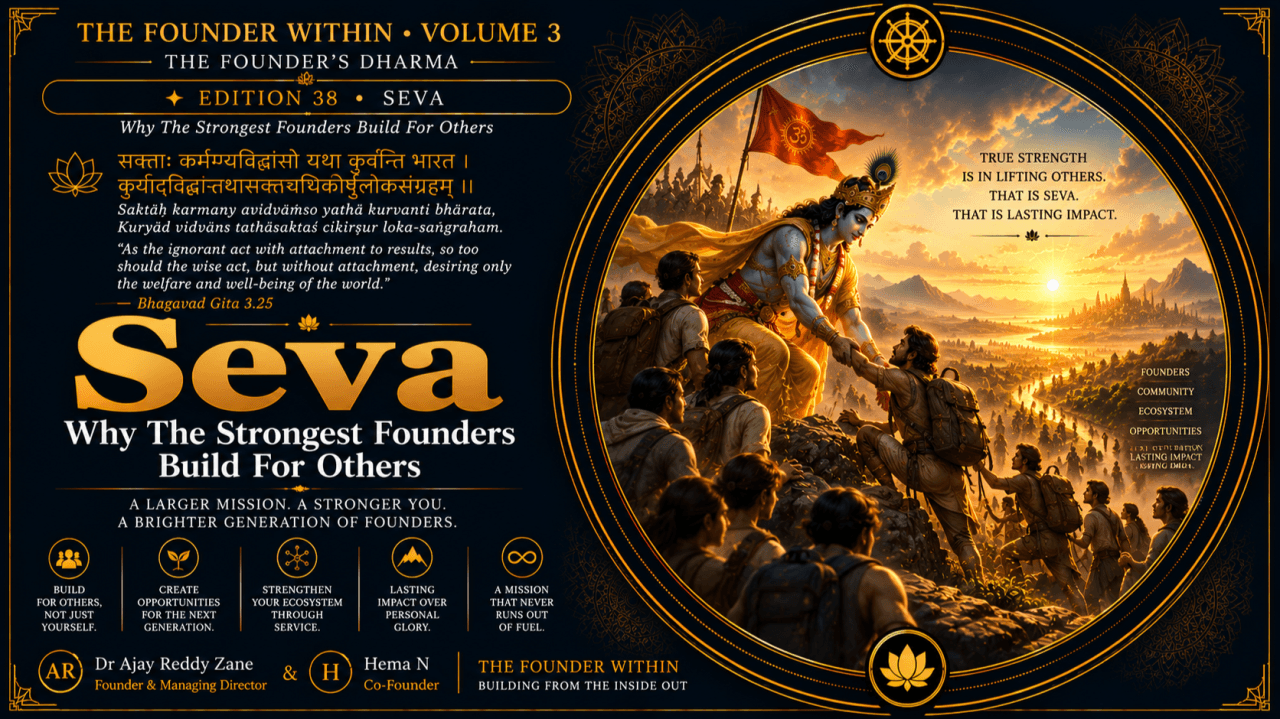
सक्ताः कर्मण्यविद्वांसो यथा कुर्वन्ति भारत। कुर्याद्विद्वांस्तथासक्तश्चिकीर्षुर्लोकसंग्रहम्॥
Saktāḥ karmaṇy avidvāṁso yathā kurvanti bhārata, Kuryād vidvāṁs tathāsaktaś cikīrṣur loka-saṅgraham.
"As the ignorant act with attachment to results, so too should the wise act, but without attachment, desiring only the welfare and well-being of the world." — Bhagavad Gita 3.25
The Epic Moment
Krishna's life, examined as a whole rather than as a series of individual episodes, has a single continuous thread running through it: seva. Selfless service, directed always toward the welfare of others, never toward personal accumulation or personal glory.
He built alliances not to expand his own kingdom, but to create the conditions for dharma to prevail. He guided Arjuna not to receive credit for the eventual victory, but because Arjuna's fulfillment of his own duty mattered more to Krishna than any personal gain the outcome might provide him. Even his decision to be a charioteer rather than a warrior — examined fully in Edition 34 — was itself an act of seva, choosing the position of service over the position of glory.
This particular verse addresses something specific about how seva actually operates in practice, and it is easy to misunderstand without careful reading. Krishna does not say the wise should act without desire entirely, or without any goal in mind. He says the wise should act loka-sangraha — for the welfare and holding-together of the world — rather than for personal attachment to results. The action itself remains full, complete, undiminished in effort. What changes is the orientation of that effort — away from the self, toward the collective.
This distinction matters because it corrects a common misreading of detachment as disengagement. Krishna is not asking Arjuna, or anyone, to care less. He is asking for care to be redirected — from personal outcome toward collective welfare — which, paradoxically, often produces more sustained effort than self-interest alone, because the fuel for that effort no longer depends on personal reward arriving on any particular timeline.
The Founder Parallel
There is a specific and common failure mode among founders that this teaching addresses directly: the founder who builds entirely for personal gain eventually runs out of fuel.
This is not a moral judgment. It is a practical observation about sustainability. Personal ambition, however genuine, is finite as a source of motivation. It depends on external validation, on outcomes arriving within a reasonable timeframe, on the specific satisfaction of seeing your own name attached to success. When that validation is delayed — as it almost always is, for years longer than any founder initially expects — ambition alone frequently cannot sustain the effort required to keep building.
Seva-oriented building operates differently. A founder who is building for their community, for their ecosystem, for the generation of founders who will come after them, has access to a fuel source that does not deplete on the same schedule as personal ambition. The mission itself becomes the source of motivation, and because the mission is larger than any single person's timeline, it does not run out simply because personal recognition has been delayed.
This connects directly to everything Edition 34 established about ecosystem building. If the highest form of building is creating the conditions in which others can win their own battles, seva is the underlying motivation that makes that kind of building sustainable over years rather than months. You cannot maintain the discipline of stepping back, of letting others take the visible win, of building infrastructure rather than personal glory, unless something deeper than personal ambition is driving the effort.
Ajay's Experience
The oath described in Chapter Two of this book was never, from the moment I made it, primarily about me.
I want to be precise about this, because it is easy to retroactively frame an origin story as more selfless than it actually was in the moment. The oath — three generations settled through whatever I built — was specific and personal. It included me. But it was never centered on me in the way that would have made it fragile the moment personal reward was delayed, which it was, repeatedly, across eight years of building.
What has sustained the Elfinity Group through six betrayals, multiple collapses, and years where the outcomes were not arriving on any timeline I had imagined, was never primarily the prospect of my own success. It was the specific, ongoing awareness that every vertical we build — Startup Synerz, BSBE, Elfinity Ventures, Founders Matrimony — exists because founders inside our ecosystem needed something that did not yet exist, and building it mattered more than whether I personally received credit for having built it.
I have watched founders in our community succeed using resources, connections, and programs that Elfinity Group built specifically so they would not have to struggle the way I struggled. In most of those cases, I am not visible in their success story at all. I am not mentioned in their pitch decks or their press coverage. And I have found, consistently, that this absence of personal credit does not diminish my motivation to keep building. If anything, it confirms that the ecosystem is functioning exactly as intended — the way Krishna's guidance functioned for Arjuna, present in the outcome without needing to be visible in it.
Hema's Voice
I want to add something to this teaching that comes from a specific shift in how I understand my own work at Startup Synerz Global.
Before my team collapsed, I measured my building, at least partly, by what it would eventually produce for me personally — recognition, financial security, the specific validation of having built something that worked. That is not shameful to admit. It is simply how most people, myself included, initially understand what building is for.
What changed, in the process of rebuilding after that collapse, was a slow shift in what actually sustained me through the hardest parts of starting over. It was not the prospect of eventual personal reward, because for a long stretch of that rebuilding, personal reward felt genuinely uncertain. What sustained me, increasingly, was something closer to what this teaching describes — the specific satisfaction of seeing something I had built actually help someone else, regardless of whether that help was ever traced back to me.
Today, in my role leading community, events, and global expansion at Startup Synerz Global, the moments that matter most to me are rarely the ones where our ecosystem receives credit. They are the quieter moments — a founder finding the co-founder they needed through our community, a woman entrepreneur telling me she finally felt safe enough to keep building because of something we created — where the seva itself is the entire reward, whether or not it is ever visibly attributed to us.
I do not think I could sustain the pace of building an ecosystem across multiple countries, the way we are now attempting, if the fuel were personal recognition alone. It has to be something closer to what this teaching describes — building for the welfare of the founders in our ecosystem, because that welfare matters on its own terms, not because of what it eventually produces for me.
The Dharma Lesson
Krishna's teaching in this verse does not ask founders to abandon ambition or personal goals entirely. It asks for those goals to be held alongside something larger — loka-sangraha, the welfare of the collective — so that the effort required to build does not depend entirely on personal outcomes arriving on a convenient schedule.
This is, practically, one of the most important teachings in this entire volume for founders specifically, because building anything lasting requires years of effort that will not be adequately rewarded by personal recognition alone, especially in the early seasons when that recognition has not yet arrived and may not arrive for far longer than initially expected.
Seva is not weakness. It is not the abandonment of ambition or the pretense that personal reward does not matter. It is the deliberate redirection of a portion of your motivation toward something that does not run out on the same schedule personal ambition does — the welfare of your community, your ecosystem, the founders who will come after you.
The founders who build for themselves eventually run out of fuel. The founders who build for others — for their community, their ecosystem, the generation that comes after them — never run out of reason to keep going.
Build for others. Not instead of building for yourself, but alongside it, as the deeper and more sustainable source of everything the harder seasons of building will eventually require of you.
Continued in Edition 15 — The Geeta Was Given On A Battlefield: Wisdom Arrives In Pressure, Not Comfort