Volume 3 · Edition 13 · 14 Oct 2026
THE FOUNDER'S DHARMA - "Viveka" The Discernment That Separates Builders From Dreamers
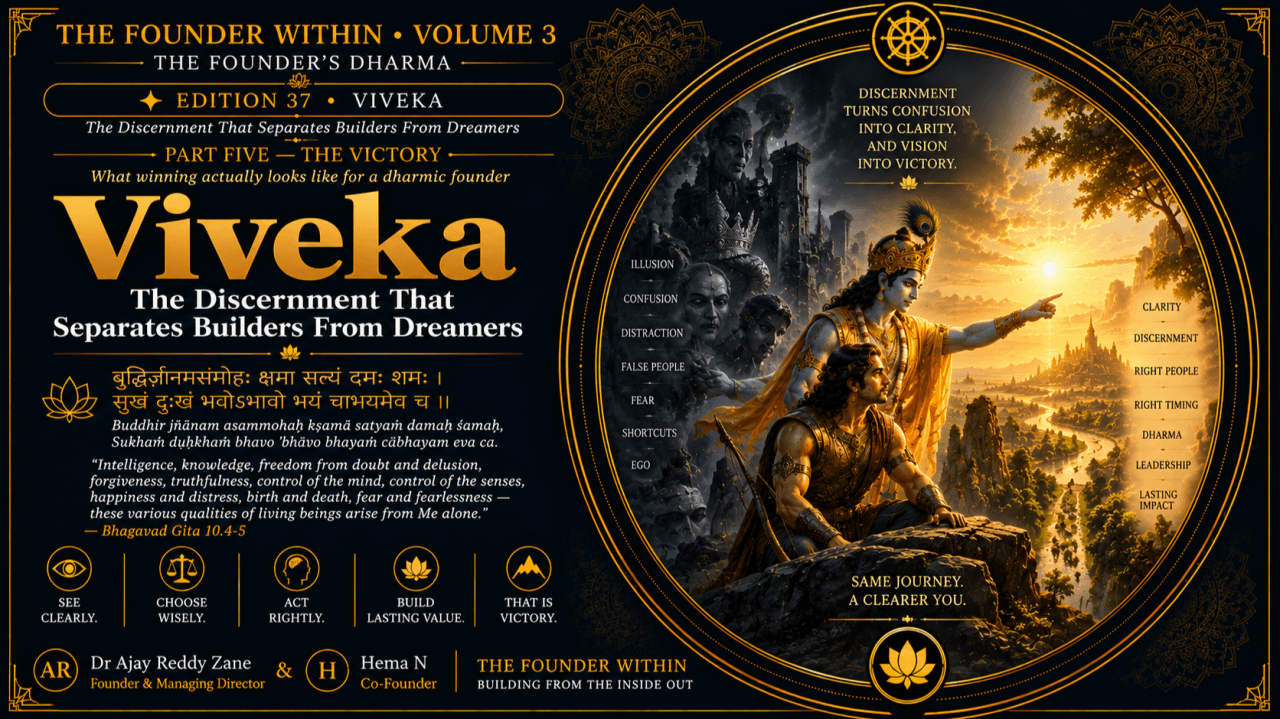
बुद्धिर्ज्ञानमसंमोहः क्षमा सत्यं दमः शमः। सुखं दुःखं भवोऽभावो भयं चाभयमेव च॥
Buddhir jñānam asammohaḥ kṣamā satyaṁ damaḥ śamaḥ, Sukhaṁ duḥkhaṁ bhavo 'bhāvo bhayaṁ cābhayam eva ca.
"Intelligence, knowledge, freedom from doubt and delusion, forgiveness, truthfulness, control of the mind, control of the senses, happiness and distress, birth and death, fear and fearlessness — these various qualities of living beings arise from Me alone." — Bhagavad Gita 10.4-5
The Epic Moment
There is a specific quality the Gita returns to again and again, under different names in different chapters, that deserves its own dedicated examination: viveka.
Viveka is usually translated as discrimination or discernment, but neither word fully captures what the term describes. It is the specific capacity of the intellect to distinguish — cleanly, reliably, without being clouded by desire, fear, or attachment — between what is real and what is illusion, between what ought to be done and what ought not to be done, between the path that leads toward liberation and the path that merely appears to.
Krishna's greatest gift to Arjuna across the entire Gita is not strategy. It is not even courage, exactly, though courage follows from what Krishna provides. It is viveka — the restoration of Arjuna's capacity to see clearly what was right in front of him the entire time, obscured not by lack of information but by grief, attachment, and confusion.
This is worth sitting with, because it reframes what Arjuna's crisis at the start of the Gita actually was. He did not lack the physical capability to fight. He did not lack knowledge of dharma in the abstract. What he lacked, in that frozen moment, was the clarity to apply what he already knew to the specific, difficult situation directly in front of him. His intellect had been clouded — not by stupidity, but by the specific, human confusion that arises when love, fear, and duty pull in different directions simultaneously.
Krishna's teaching restores viveka. Not by giving Arjuna new information he did not already possess, but by clearing away the confusion that had made his existing knowledge inaccessible to him in the moment he needed it most.
The Founder Parallel
The founders who build lasting companies are rarely the most talented, the most capitalized, or the most connected. They are, with striking consistency, the ones with the clearest discernment — about people, about opportunities, about when to move decisively and when to wait.
This edition sits at the opening of Part Five deliberately, because everything this book has taught across the preceding thirty-six editions has been building toward exactly this capacity. The seven masks and four dangerous personality types from Part Three exist to sharpen your discernment about people. The triggers, blind spots, and the Helper Wound from Part Four exist to sharpen your discernment about yourself. The Trust Spectrum and the inner circle teachings exist to give that discernment a structural home, rather than requiring it to be re-derived from scratch in every single interaction.
Viveka is not a talent some founders are born with and others are not. It is built, specifically, through the accumulation of tested experience — through getting it wrong enough times, with enough honest reflection afterward, that the pattern eventually becomes visible before the cost arrives rather than only after.
This is the essential distinction between a builder and a dreamer, in the sense this edition's title intends. A dreamer has vision without the discernment to execute it safely — they see what could be built, but cannot reliably distinguish the person who will help build it from the person who will dismantle it, or the decision that will advance the mission from the decision that merely feels exciting in the moment. A builder has developed viveka alongside vision — the capacity to see clearly, and to act on what is seen, even when doing so is uncomfortable or unpopular.
Ajay's Experience
I did not have viveka when I started this journey. I had conviction, which is not the same thing, and which I sometimes mistook for it.
Conviction told me that a vision was worth pursuing. It did not, by itself, tell me which people were genuinely aligned with that vision and which were performing alignment to gain access to it. Conviction told me to keep building after every collapse. It did not, by itself, tell me which specific decisions within that building were sound and which were driven by the Helper Wound, or the Injustice Trigger, or simple exhaustion masquerading as urgency.
Viveka arrived slowly, and expensively, across eight years — sharpened specifically by every one of the six betrayals described in Chapter Three. Each one taught me something I could not have learned any other way: what a specific kind of deception actually feels like from the inside, before it has fully revealed itself. Each restart refined the pattern further, until the frameworks documented across this entire book — the masks, the trust levels, the warning signs — became something closer to instinct than deliberate calculation.
I want to be honest that viveka, even now, is not perfect or complete. I still occasionally misjudge a person or a situation. What has changed is the speed and the cost of that misjudgment. Where earlier betrayals took years to fully recognize and cost enormous amounts before I understood what had happened, more recent misjudgments are typically caught within weeks, sometimes days — because the discernment built through everything documented in this book now operates faster than conscious analysis, the way genuine expertise eventually does in any domain.
Every right decision I have made in building the Elfinity Group, especially in recent years, has come from clarity built through the wrong ones that preceded it. That is not an efficient way to build discernment. It is, as far as I have found, the only reliable way.
The Dharma Lesson
The qualities Krishna lists in this passage — intelligence, freedom from delusion, forgiveness, truthfulness, control of mind and senses — are presented as arising from a single source, suggesting they are not separate talents to be developed independently, but different expressions of the same underlying clarity.
Viveka, in this sense, is not one skill among many that a founder needs. It is the foundation from which every other capability documented in this book actually functions correctly. Without it, the seven masks remain theoretical categories rather than tools you can apply in real time. Without it, the Trust Spectrum becomes a framework you understand intellectually but fail to apply when a compelling person is standing in front of you asking for access they have not yet earned.
Discernment is not born. It is built — through experience, through honest reflection on that experience, and through the specific willingness to learn from every outcome, including and especially the outcomes that cost you something significant to learn from.
The founders who build lasting companies are not the most talented or the most funded. They are the ones with the clearest discernment — about people, about opportunities, about when to move and when to wait.
This is where Part Five begins, because everything that follows — the discernment covered in this edition, the seva described in the next, the closing teaching of the entire volume — depends on having built exactly this capacity first. Not perfectly. Not completely. But genuinely, through the same hard-earned process this entire book has documented from the beginning.
A builder is not someone who never gets it wrong. A builder is someone whose viveka improves, deliberately, every time they do.
Continued in Edition 14 — Seva: Why The Strongest Founders Build For Others