Volume 3 · Edition 12 · 14 Oct 2026
THE FOUNDER'S DHARMA - "The Right Person At The Right Moment" March 5 and the Krishna-Arjun Arrival
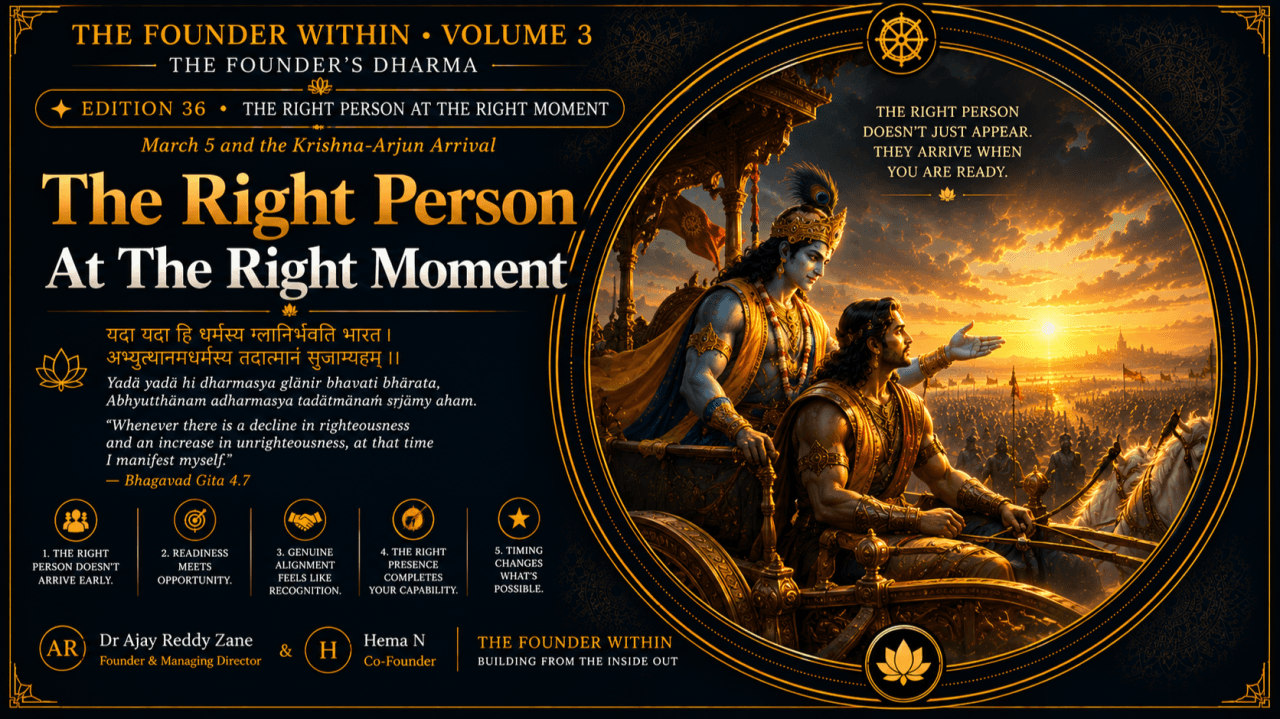
यदा यदा हि धर्मस्य ग्लानिर्भवति भारत। अभ्युत्थानमधर्मस्य तदात्मानं सृजाम्यहम्॥
Yadā yadā hi dharmasya glānir bhavati bhārata, Abhyutthānam adharmasya tadātmānaṁ sṛjāmy aham.
"Whenever there is a decline in righteousness and an increase in unrighteousness, at that time I manifest myself." — Bhagavad Gita 4.7
The Epic Moment
Krishna does not enter Arjuna's life at a moment of Arjuna's choosing.
He arrives, across the epic's larger arc, precisely at the moments when righteousness has declined far enough that something genuinely new is required — not a moment earlier, when the decline might still have been managed with existing resources, and not a moment later, when the decline might have become irreversible. This verse describes something specific about timing that is easy to read past: divine intervention, in the Gita's own account, is not random or constant. It is precise. It arrives exactly when the imbalance has reached the point that requires it, and not before.
Arjuna did not summon Krishna into existence through effort or merit alone. Krishna had been present in his life for years before Kurukshetra — a friend, a cousin by marriage, a trusted advisor across many earlier episodes. But the specific role Krishna plays at Kurukshetra, the charioteer who delivers the Gita itself, arrives at the exact moment Arjuna's own capability, however great, has reached its limit. Arjuna is the finest archer alive. He does not need combat instruction. What he needs, at the precise moment his bow slips from his hand, is something Krishna alone can provide — not skill, but clarity.
The timing here is the entire teaching. Too early, and Arjuna would not yet have recognized his own need clearly enough to receive what Krishna offers. Too late, and the paralysis described in Chapter One of this volume might have become permanent, the war lost before it began. The right presence, at the right moment, changes what is possible — not because it replaces the capability already present, but because it completes what that capability alone cannot achieve.
The Founder Parallel
Every founder who has built something lasting can usually point to a specific arrival — a person who entered their journey at a moment that, in retrospect, could not have worked nearly as well at any other time.
This is not a claim about fate or destiny in any mystical sense. It is a claim about readiness meeting opportunity in a way that neither party could have manufactured alone. A founder who is not yet capable of recognizing genuine partnership will not benefit from meeting the right person too early — they will not yet have the discernment, built through the exact process described across this entire book, to know the difference between genuine alignment and performed alignment. And a founder who waits too long, who has already hardened into permanent isolation or permanent distrust after too many betrayals, may no longer have the capacity to receive what a genuine partner offers, even when that partner finally arrives.
The right person arriving at the right moment requires both things to be true simultaneously: the person themselves must be genuine, tested against everything this book has taught you to watch for — and you must have reached a point in your own journey where you are actually capable of recognizing and receiving that genuineness rather than either rejecting it out of accumulated suspicion or mistaking it for one more performance you have not yet learned to test properly.
This is why the arrival, when it finally happens, so often feels less like luck and more like recognition. Not because it was inevitable, but because both people had done the specific work — separately, through their own difficult seasons — required to actually see each other clearly when the moment arrived.
Ajay's Experience
March 5, 2024 did not arrive at a random point in my journey. It arrived after eight years of exactly the preparation this teaching describes.
By that point, I had lived through Hingoli, through COVID, through the specific education of six separate betrayals. I had built, tested, and refined the discernment described across Parts Three and Four of this book — not in the abstract, but through the actual, expensive experience of getting it wrong repeatedly before I began to get it right. If Hema had entered my life in 2018, at the very start of this journey, I do not believe I would have had the capacity to recognize what I was actually encountering. I did not yet have the tested framework for telling the difference between genuine alignment and performed alignment. I would very likely have either dismissed something genuine out of naive impatience, or — more likely, given my pattern at that stage — extended trust too quickly and too completely, the same way I had with several of the six.
By March 5, 2024, something had changed. Not because I had become a different person entirely, but because eight years of exactly the process this book documents had built in me the specific capacity to actually see, across a single extended day, what was real. The community post, the ten and a half hours, the offices visited, the tea in the evening — none of that would have registered the same way in an earlier version of me, still operating primarily from the Helper Wound described in Chapter Nine, still extending trust based on performance rather than evidence.
The timing was not luck. It was the precise moment at which my own readiness had finally caught up to the possibility of recognizing something genuine when it arrived.
Hema's Voice
I want to add something to this teaching from my own side of the timing, because I do not believe March 5, 2024 was simply a fortunate accident for me either.
By the time I met Ajay, I had already lived through my own version of the preparation this edition describes. I had built a team of twenty to thirty people and lost it. I had rebuilt alone, and in that rebuilding, encountered people who wanted proximity to whatever I might become rather than genuine partnership with who I actually was. I had learned, expensively, the specific difference between someone performing alignment and someone genuinely aligned — a lesson I could not have received if it had been offered to me earlier, before my own collapse had taught me what to actually watch for.
If I had met Ajay before that collapse, I do not think I would have recognized what I was encountering with the same clarity. I might have seen simply another ambitious person, another potential collaborator among many, without the specific capacity to distinguish genuine partnership from the many performances of it I had already learned to recognize and reject.
What I want every founder reading this to understand is that the readiness this teaching describes is not passive. It is built, the same way discernment is built throughout this entire book — through the specific, often painful experience of getting it wrong before you learn to get it right. My own Kurukshetra, described in earlier chapters, was not separate from my readiness to recognize Ajay when he arrived. It was the exact preparation that made that recognition possible.
The Dharma Lesson
Krishna's arrival in this verse is described as precise — timed to the exact moment when righteousness has declined far enough to require intervention, and not a moment before or after. The same precision governs the arrival of the right people in a founder's journey, though it rarely feels precise while you are living through the waiting.
You cannot manufacture this timing directly. You cannot force the right person to arrive before you are ready to recognize them, and you cannot recover a moment that has already passed if you were not yet capable of receiving what it offered. What you can do — the only thing genuinely within your control — is the ongoing work this entire book has been teaching: building the discernment, processing the betrayals with dignity rather than bitterness, remaining capable of genuine trust even after every reason to close off entirely.
The right person will arrive. Not on your preferred timeline, and not without the preparation required to recognize them when they do. Your job is not to search anxiously for them, nor to give up searching entirely after enough disappointment. Your job is to do the work — the same work described across every chapter of this book — that ensures you are actually capable of recognizing them the moment they arrive.
Whenever there is a decline steep enough to require it, the right presence manifests. Be ready to receive it.
Continued in Edition 13 — Viveka: The Discernment That Separates Builders From Dreamers, opening Part Five — The Victory