Volume 3 · Edition 11 · 14 Oct 2026
THE FOUNDER'S DHARMA - "The Inner Circle" Who You Allow Close Changes Everything
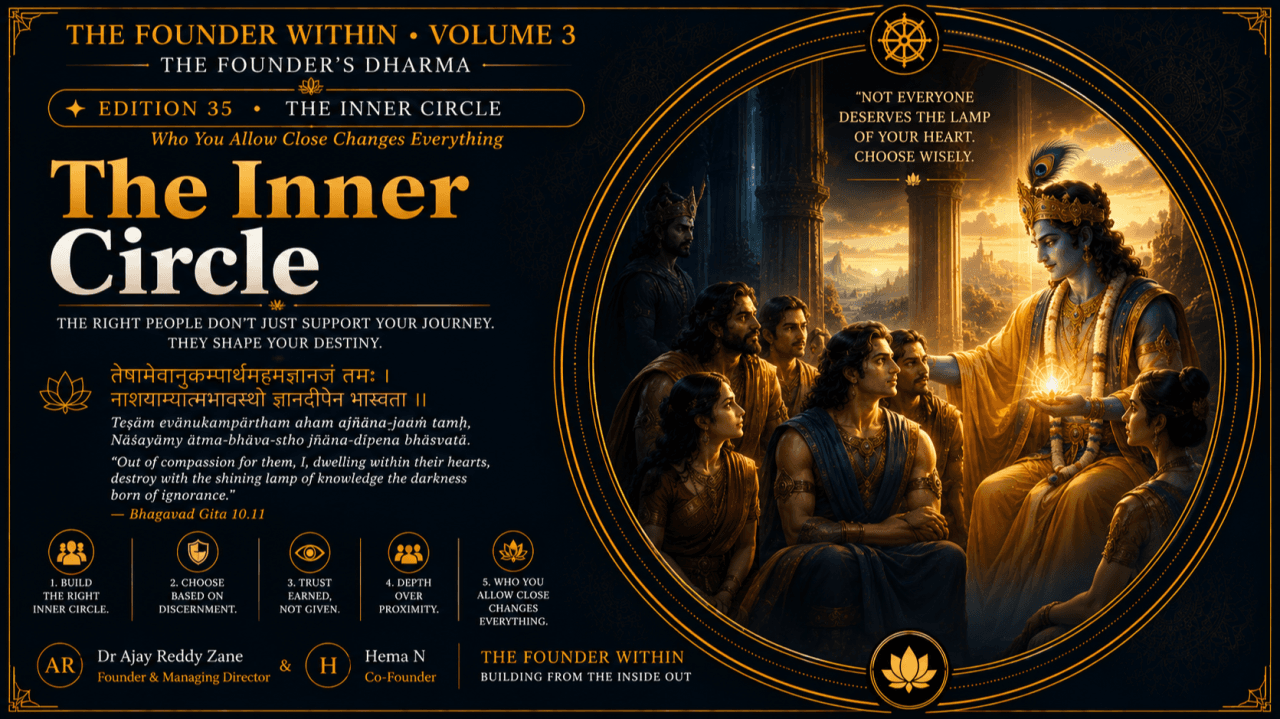
तेषामेवानुकम्पार्थमहमज्ञानजं तमः। नाशयाम्यात्मभावस्थो ज्ञानदीपेन भास्वता॥
Teṣām evānukampārtham aham ajñāna-jaṁ tamaḥ, Nāśayāmy ātma-bhāva-stho jñāna-dīpena bhāsvatā.
"Out of compassion for them, I, dwelling within their hearts, destroy with the shining lamp of knowledge the darkness born of ignorance." — Bhagavad Gita 10.11
The Epic Moment
Krishna knew everyone. He was courteous with kings, respected by sages, related by blood or marriage to nearly every major house in the epic — including, directly, the Kauravas themselves. Duryodhana was his cousin as much as Yudhishthira was. When the war became unavoidable and both sides sought Krishna's support, he offered Duryodhana a genuine choice — an entire army on one side, or Krishna himself, unarmed, on the other. He was fair. He was never unkind to those outside his innermost trust.
But he did not dwell in every heart the way this verse describes dwelling in Arjuna's.
That distinction matters enormously, and it is easy to miss if you read Krishna's universal compassion as meaning universal intimacy. He extended justice, respect, and even counsel to people far outside his inner circle. Duryodhana received an audience, a genuine offer, and honest terms — the same courtesy any king in that world would expect from another. But the closeness described in this verse — dwelling within someone's heart, destroying the darkness of their ignorance with a lamp lit specifically for them — was reserved. Given to Arjuna. To the Pandavas as a unit. To Draupadi. To a small number of people who had, over years, demonstrated something that made that depth of investment worthwhile.
This was not favoritism in the petty sense. It was discernment applied consistently, even toward family, even toward people with every surface-level claim to closeness. Krishna's cousin by blood did not receive what Krishna's chosen inner circle received. Proximity of birth was never, in his practice, the same as earned intimacy.
The lamp Krishna lights in this verse is not lit for everyone equally. It is lit, deliberately, for those who have shown they are ready to carry its light forward.
The Founder Parallel
This edition builds directly on the Trust Spectrum introduced in Chapter Twelve, but it addresses something that framework alone does not fully capture: the specific, disproportionate impact of who occupies your innermost circle, as distinct from everyone else in your ecosystem.
Most founders understand, intuitively, that they cannot extend deep trust to everyone. What is harder to internalize is how much the quality of the small number of people at the very center actually determines the trajectory of everything else. This is not primarily about the size of your network, your community, or even your team. It is specifically about the handful of people who hold genuine Level Four trust — vision-level involvement, tested loyalty, honesty even when it costs them something.
One wrong person occupying that innermost position costs more than ten right people kept, appropriately, at Levels One or Two. This is precisely what the six betrayals in Chapter Three demonstrated in painful detail — several of those six had more surface-level claim to closeness than the people who eventually earned genuine trust. A childhood friendship. A formal partnership agreement. A title. None of these, on their own, constitute the discernment-tested closeness this edition is describing.
Krishna's example is instructive precisely because it shows that fairness toward everyone and intimacy with a chosen few are not in conflict. You can treat every person in your ecosystem with genuine respect, offer honest terms even to those who may become adversaries, and still reserve your innermost trust for the small number who have actually earned it through demonstrated behaviour over time.
Ajay's Experience
Hema, Mani Apparsamy, Prachi, Vinod, Pradeep — each occupies a place in my inner circle that took years, not months, to earn.
I want to be specific about what makes this different from the six people described in Chapter Three, because the comparison is instructive. The Childhood Friend had years of history with me — arguably more surface-level claim to closeness than Mani had when he first entered my world. What Mani demonstrated, and what the Childhood Friend never did, was loyalty tested specifically when it cost him something, honesty delivered even when it was inconvenient for both of us, and a consistency across years that never wavered when the ecosystem was struggling rather than succeeding.
The distinction is not about how long someone has known you, or what title they hold, or how the relationship began. It is about whether, tested across real conditions — pressure, scarcity, disagreement — the person consistently shows up as who they claimed to be from the start.
I have had to be honest with myself, more than once, about people who had every surface-level qualification for inner circle status and simply had not earned it yet, regardless of how uncomfortable that honesty felt in the moment. Being fair to someone, respecting them, working alongside them productively — all of this remains possible without extending the specific depth of trust that belongs only to the people who have genuinely earned it.
Hema's Voice
I want to add something to this teaching that comes from watching my own inner circle form, separately from simply inheriting Ajay's.
When I began building alongside Ajay, I did not automatically extend the same trust to Mani, Prachi, Vinod, and Pradeep simply because they held that place in his world. I watched them, over time, the same way this book has taught founders to watch anyone before extending real trust. What I saw, across real situations — not just comfortable ones — was consistency. People who showed up the same way whether or not there was anything visible to gain from the interaction.
That mattered to me specifically because of what I had lived through before meeting Ajay. During the period after my team collapsed, several people who claimed closeness to me were, in reality, positioned around the opportunity my situation presented rather than around me as a person. I had learned, expensively, not to mistake proximity for trust.
So when I entered this new circle, I chose it as much as I inherited it. Today, I consider Mani, Prachi, Vinod, and Pradeep part of my own inner circle, not simply people who happen to be close to my co-founder. That distinction matters to me. An inner circle that is genuinely shared, built through each person's own discernment rather than simply deference to one founder's existing relationships, is far more resilient than one person's circle that everyone else is simply expected to accept.
The Dharma Lesson
Krishna's compassion, described in this verse, was universal in its fairness and deliberate in its intimacy. He did not withhold justice or respect from anyone. He reserved the deeper closeness — dwelling within the heart, lighting the lamp that destroys ignorance — for those who had shown, over time, that they were ready to carry it.
Your inner circle is not a networking decision. It is not determined by tenure, by how the relationship began, or by an accident of who happened to be around in your earliest days. It is a dharma decision — made deliberately, revisited continuously, and protected with the same discernment this entire book has been teaching you to apply everywhere else.
Who you allow close changes everything. Not because everyone outside that circle deserves less respect or less fairness — Krishna's example proves the opposite is true. But because the small number of people who hold your deepest trust will shape, more than any strategy or any market opportunity, what you are actually capable of building.
Choose that circle the way Krishna chose his. Not by blood. Not by title. Not by how long someone has been standing near you.
By what they have actually shown you, over time, when it cost them something to show it.
Continued in Edition 12 — The Right Person At The Right Moment: March 5 and the Krishna-Arjun Arrival