Volume 3 · Edition 10 · 14 Oct 2026
THE FOUNDER'S DHARMA - "Krishna Never Fought The War" The Ecosystem Builder's Dharma
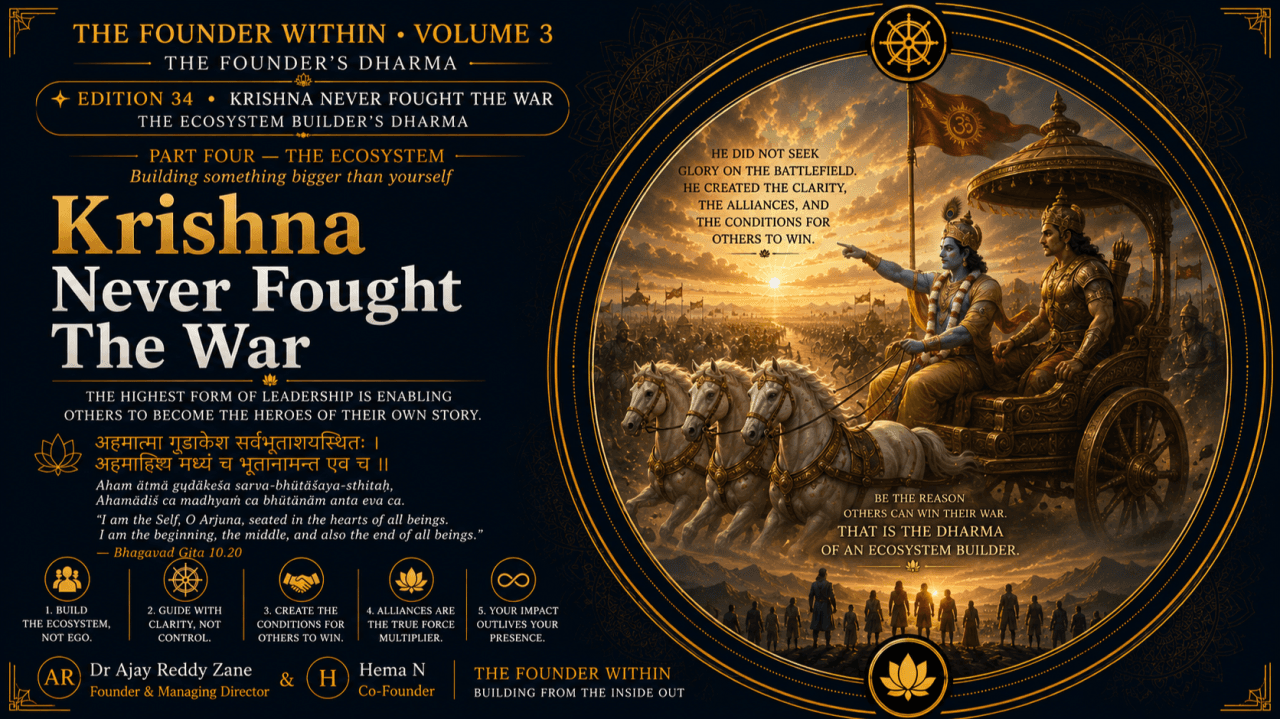
अहमात्मा गुडाकेश सर्वभूताशयस्थितः। अहमादिश्च मध्यं च भूतानामन्त एव च॥
Aham ātmā guḍākeśa sarva-bhūtāśaya-sthitaḥ, Aham ādiś ca madhyaṁ ca bhūtānām anta eva ca.
"I am the Self, O Arjuna, seated in the hearts of all beings. I am the beginning, the middle, and also the end of all beings." — Bhagavad Gita 10.20
The Epic Moment
There is a fact about Krishna's role at Kurukshetra that gets overlooked precisely because it is so unexpected.
He was, by nearly every account the epic offers, among the most powerful beings present on that battlefield. He had access to the Sudarshana Chakra. He had, in earlier episodes, defeated forces that no mortal warrior could stand against. If Krishna had chosen to fight directly, using his full capability, there is a genuine argument that the eighteen days of war at Kurukshetra could have been resolved in far less time, with far less loss on both sides.
He chose, instead, to be a charioteer.
Not a general commanding troops from a position of authority. Not a warrior in the front line collecting glory. A charioteer — holding the reins of one man's chariot, positioned specifically so he could see the battlefield clearly and offer Arjuna guidance, but never once lifting a weapon himself throughout the entire war.
This choice is not incidental to the story. It is, in many readings, the actual heart of what the Bhagavad Gita is teaching. Krishna's power was expressed entirely through what he enabled in others — through the clarity he gave Arjuna in Chapter Two, through the alliances he helped build before the war began, through the specific guidance offered at exactly the moments it was needed, and withheld at the moments where Arjuna needed to act on his own judgment.
The war was won by the Pandavas. By Arjuna's skill, by Bhima's strength, by Yudhishthira's eventual restoration of dharma. Krishna's victory was different in kind — not a victory of personal combat, but the victory of having built the conditions, the alliances, and the clarity in which the right people could fight and win their own battles.
He is described, in this verse, as seated in the heart of all beings — the beginning, the middle, and the end of everything. Not because he did everything personally. Because everything that happened, happened through what he had made possible in others.
The Founder Parallel
This edition marks a genuine turn in the arc of this book, and it is worth naming that turn directly.
Everything described across Parts One through Three has, in its own way, been about protection. Understanding your own origin and wound. Recognizing the six betrayals and the pattern beneath them. Learning to read masks, dangerous personality types, triggers, and the Helper Wound. Building the Trust Spectrum and learning to rebuild with dignity after adharma reveals itself.
All of that work is necessary. None of it is optional. But none of it, by itself, builds anything larger than a single, well-protected founder.
Part Four is about something different — the mature, generative work of building an ecosystem that outlasts and exceeds any single person inside it. And the central teaching of this part begins with an uncomfortable question for most founders, who are often drawn to building precisely because they want to be the one who solves the problem, wins the deal, closes the round, gets the credit.
What if the highest form of building is not doing the thing yourself? What if it is creating the conditions in which other people can do their best work, win their own battles, and become the hero of their own story — with you, like Krishna, positioned not at the center of the glory but seated quietly at the heart of what makes it all possible?
The greatest founders are rarely the ones who personally do everything. They are the ones who build the systems, the community, and the trust structures — the same Trust Spectrum described in Chapter Twelve, extended now beyond personal relationships into the architecture of an entire ecosystem — where other people can do their best work.
This does not mean stepping back from the fight entirely. Krishna was present for all eighteen days. He was engaged, attentive, guiding at every critical juncture. The lesson is not disengagement. It is a fundamentally different relationship to what building actually means — from personally winning every battle, to becoming the reason other people can win theirs.
Ajay's Experience
Every vertical of the Elfinity Group exists because of a decision I made, somewhere in the years after the six betrayals, that I did not fully understand the significance of at the time.
I stopped asking, primarily, what do I need to build next? and started asking, what do the founders in this ecosystem need that does not yet exist?
That shift sounds subtle, but it changes everything about how you build. Startup Synerz was not built for my personal visibility. It was built because I had experienced, directly, what it costs to have no community of founders who understand what you are carrying. BSBE was not built because I wanted to run a school. It was built because I had to learn everything the hard way, through six expensive betrayals, and I did not want the next generation of founders to pay the same tuition I paid.
Elfinity Ventures, World Investors Circle, Founders Matrimony, Elfinity Foundation — every one of these exists not because I personally needed them, but because 3,000-plus founders across our community needed something that did not yet exist, and building it for them mattered more than building something that centered me.
This is the specific discipline Krishna models at Kurukshetra. I could, in theory, have positioned myself as the founder who personally solves every problem for every person in our ecosystem — the visible hero at the center of every story. That would have felt, in the moment, more satisfying. It would also have been structurally limited to whatever a single person can personally do.
Instead, the Elfinity Group exists as a set of conditions — communities, systems, trust structures, capital pathways — in which founders can fight and win their own battles, the way Arjuna won his. My role, increasingly, is closer to the charioteer than the warrior. Present. Attentive. Offering clarity at the moments it is genuinely needed. But the actual battles — the actual building, the actual wins — belong to the founders inside the ecosystem, not to me.
Hema's Voice
I want to speak to this teaching from a place I understand more personally than perhaps any other lesson in this entire book.
I have lived both sides of what Krishna's choice actually means.
Before I met Ajay, I built alone, and I tried to be everything at once — the warrior fighting every battle myself. When my team collapsed while I was away, it was not simply bad luck. It was the direct consequence of having built something that depended entirely on me being personally present for every decision, every relationship, every operational detail. I had not built an ecosystem. I had built a structure that could only exist as long as I personally held it together.
When it collapsed, I understood something I could not fully articulate at the time, but that this teaching now gives me language for. I had been trying to be the warrior, the strategist, and the entire army, all at once. There was no Krishna in that structure — no one holding the reins so that I could see clearly, no distributed capability that could survive my own absence.
What changed, once Ajay and I began building together, was not simply that I had a partner. It was that we began building Startup Synerz Global as something that did not depend entirely on either of us personally showing up for every single decision. Systems. Community structures. Trust levels, the way this book has described them. A genuine ecosystem, rather than two people trying to personally do everything.
My role today, across community, events, and partner relations, is closer to what this edition describes than I initially expected it to be. I am not trying to personally solve every founder's problem who comes into our ecosystem. I am trying to build the conditions — the right room, the right introduction, the right structure — in which that founder can solve their own problem, the way Arjuna had to draw his own bow.
That is a very different kind of building than what I was doing before I met Ajay. It is harder to see your own impact directly, because the wins belong to the founders themselves, not visibly to you. But it is the only kind of building that survives your own absence — which is exactly the lesson my first collapse should have taught me, and exactly what building alongside the right person finally did.
The Dharma Lesson
Krishna is described in this verse as seated in the heart of all beings — the beginning, middle, and end of everything that happens. Not because he personally executed every action. Because everything that happened, happened through what he had made possible.
This is the dharma of the ecosystem builder, and it is a genuinely different discipline from everything Parts One through Three of this book have taught. Protecting yourself, understanding your own psychology, rebuilding after betrayal — all of that work makes you a founder capable of surviving. This teaching is about becoming a founder capable of building something that survives you.
The highest form of building is building for others.
Not instead of fighting your own battles — you still have those, and this book has spent three full parts preparing you for them. But understanding, as you scale, that the most durable and expansive form of impact rarely comes from personally winning every battle yourself. It comes from creating the ecosystem — the alliances, the clarity, the trust structures — in which the right people can win their own.
Build the ecosystem. Let others win their wars.
Continued in Edition 11 — The Inner Circle: Who You Allow Close Changes Everything