Volume 3 · Edition 1 · 14 Oct 2026
THE FOUNDER'S DHARMA - The Battlefield Before The Battle
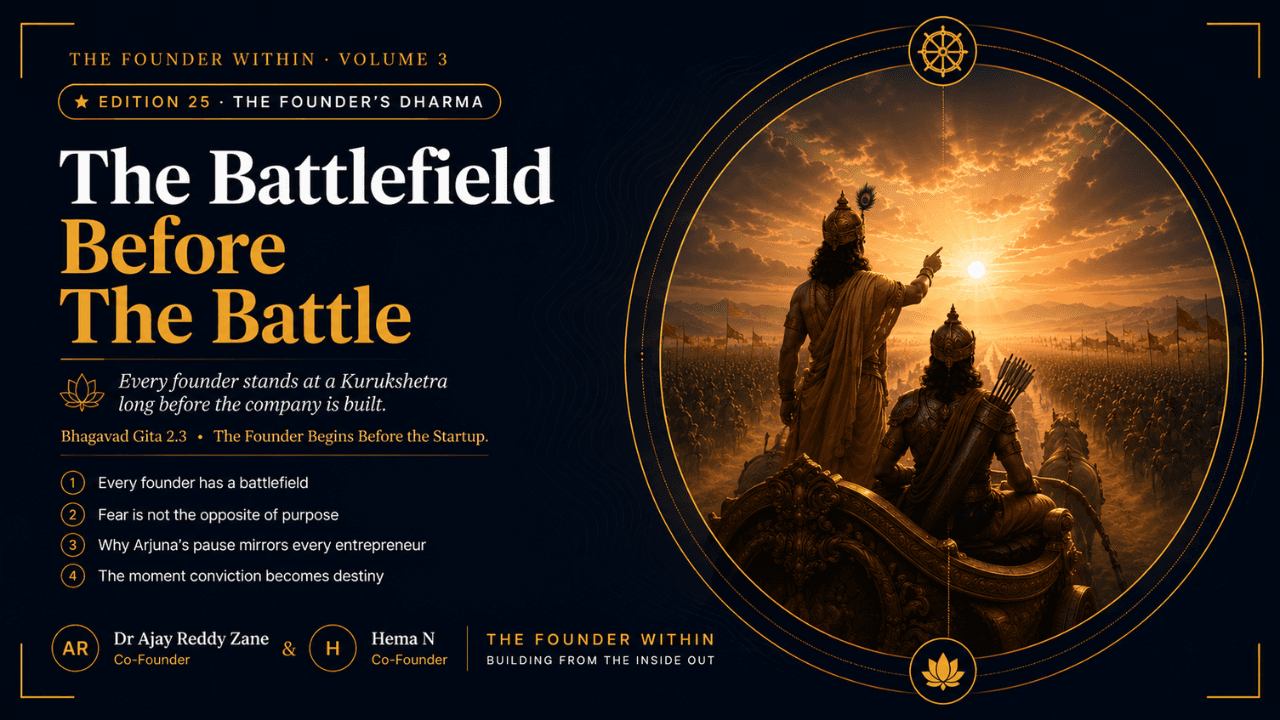
क्लैब्यं मा स्म गमः पार्थ नैतत्त्वय्युपपद्यते। क्षुद्रं हृदयदौर्बल्यं त्यक्त्वोत्तिष्ठ परन्तप॥
Klaibyam mā sma gamaḥ pārtha naitattvayyupapadyate, Kṣudraṁ hṛdaya-daurbalyaṁ tyaktvottiṣṭha parantapa.
"Do not yield to impotence, O Arjuna. It does not befit you. Shake off this faint-heartedness of the heart and arise, scorcher of enemies." — Bhagavad Gita 2.3
The Epic Moment
There is a silence in the Mahabharata that most people skip past on their way to the more famous verses. It lasts only a few lines. But everything that follows — eighteen chapters of the most studied philosophical dialogue in human history — exists because of this silence.
Arjuna stands in his chariot at the edge of Kurukshetra. Krishna, his charioteer, has just driven him to the center of the battlefield, between the two armies, so that Arjuna can see exactly who he is about to fight.
And what Arjuna sees breaks something in him.
Not enemies. Family. His cousins, the Kauravas, whom he grew up alongside. His grand-uncle Bhishma, who taught him how to hold a bow before he could walk properly. His guru Dronacharya, the man who shaped him into the finest archer in the world. Uncles. Friends. Men who had fed him, corrected him, celebrated him — standing now on the other side of a war that both sides know is coming.
Arjuna does not fear death. He has never feared death. He is Arjuna — the warrior whose name alone ends most conversations about who is the greatest fighter alive.
What breaks him is something else entirely. It is the sudden, complete understanding of what victory will actually cost. Not in land. Not in wealth. In himself. In who he will have to become to walk through this day and come out the other side.
His bow, Gandiva — the weapon he has carried through every battle of his life — slips from his hand.
He sits down in his own chariot.
"Kripaya paraya avishto" — overcome by deep compassion, he tells Krishna he cannot do this. He would rather be killed, unarmed, than lift a weapon against these people. He would rather beg on the streets for the rest of his life than win a kingdom bought with this kind of blood.
This is not cowardice. The text is careful never to call it that. This is a man of extraordinary capability, standing at the exact moment his capability is finally required, discovering that skill was never the thing standing between him and the fight.
The thing standing between him and the fight was seeing it clearly for the first time.
And Krishna's response is not comfort. He does not say, it will be easier than you think. He does not say, I will fight it for you. He looks at his friend, sitting frozen in his own chariot with the greatest weapon in the world still warm in his open palm, and says something almost unbearably direct:
This does not become you, Arjuna. Shake off this weakness. Arise.
Not because the battle is small. Not because Arjuna's grief is wrong. But because the battlefield had not changed in the last five minutes. What changed was that Arjuna, for the first time in his life, saw the whole of it — and that seeing had to be walked through, not around.
The Founder Parallel
Every founder carries a version of this moment. It rarely arrives with the drama of a battlefield. More often it arrives quietly — in the middle of an ordinary week, on an ordinary train, in an ordinary conversation with a parent who has sacrificed everything to put you on the path they believe is safe.
It looks like a resignation letter that stays half-written for three weeks.
It looks like a business idea you've turned over in your mind for a year, told no one about, and keep finding reasons to postpone.
It looks like sitting across from your father at dinner, knowing exactly what you want to say, and saying nothing — because saying it out loud will make it real, and real is heavier than imagined.
This is the founder's Kurukshetra. Not a war with weapons. A war between the life that has been laid out for you — safe, expected, provable to everyone watching — and the life that exists only as a conviction inside you, unproven, unbacked, and entirely your responsibility to build or fail at alone.
Most people, standing at this exact edge, do what Arjuna very nearly did. They sit back down in the chariot. They pick the certainty of the world everyone else has agreed to over the uncertainty of the world only they can see. And they call this choice wisdom, because it is easier to call retreat wisdom than to call it what it often is — fear, dressed respectably.
This is not a judgment. The pull toward the safe side of the field is not weakness — it is human, and it is often built from love. Arjuna's hesitation came from love, not cowardice. A founder's hesitation, too, is rarely about a lack of belief in themselves. It is about the people who will be affected by the choice — parents who sacrificed for a different outcome, a family whose name has never known this kind of risk, a self-image built entirely around being the responsible one, the safe one, the one who does not gamble everything on a conviction nobody else can see.
But there is a truth the epic insists on, gently and then not so gently: the freeze is not evidence that you are unfit for the fight. The freeze is evidence that you have finally understood the size of what you are standing in front of.
Skill was never the missing piece. Clarity was.
Ajay's Experience
I did not freeze on a battlefield. I froze on a train.
The journey between my village and Vijayawada took twelve hours on a good day, fourteen on a bad one. I made that trip more times than I can count during my B.Tech years — sitting by the window, watching people board and disembark at every small station, watching entire lives pass through those compartments in the space of a few minutes.
And somewhere in those long, unremarkable hours, a question started forming that I could not put back down once it had arrived.
I was studying to get a job. That had always been the plan — not one I had chosen exactly, but one that had been built for me, brick by brick, out of everything my parents had sacrificed to make possible.
My father, Ramachandra Reddy, was the youngest of seven children in a joint family in Gundi Settipalli, Chittoor District. He had asthma as a boy, and no one in that family gave him the medicine, or the education that might have made his life easier. His own brothers used him as labor. When it came time for him to marry, there was no ceremony fit for the word — a friend loaned a small sum, and that was the wedding. He was given a small piece of land when the family property was divided, and even then, whatever he earned through struggle, his brothers found ways to take.
My mother, Sujatha, was married to him at eighteen. Her education stopped at ninth class — not because she lacked the mind for more, but because the family decided a girl's schooling mattered less than a boy's. She is, by every account including my own, one of the sharpest people I have ever known. She now leads women's organizations across several villages, carrying twenty years of financial literacy that no classroom ever formally gave her.
Between the two of them, they spent nearly twenty-seven years building a house — starting when I was around three years old, finishing only after I completed my graduation. Twenty-seven years of failed crops, mounting debts, and a decision made early and never once reconsidered: their sons would study in English medium, no matter what it cost them.
I asked my father once, during intermediate college, why he had put himself through so much for our education. His answer has stayed with me since:
"We shouldn't have told you then. That's why we put you in English medium. You should be well-off."
He had carried the weight of that sacrifice silently, deliberately, so that I would never feel obligated to carry it back.
This was the debt I was studying to repay. Not in money — in outcome. Get the degree. Get the job. Take care of them the way they had never been taken care of. That was the unspoken contract, the one I had never questioned until those long train rides began pulling something loose inside me.
I started watching people differently on those journeys. Watching the exhaustion in men my father's age, still working the same job at fifty they had started at twenty-five, still worried about the same things. And a thought arrived that I did not invite and could not dismiss:
If I study hard, get a good job, and still spend my entire life working, still carrying the same financial weight my parents carried, still unable to fully rest — what exactly will have changed?
I would simply be living the same struggle in a different uniform.
This did not feel like ambition. It felt closer to dread. The safe path — the one everyone around me had walked, the one my parents had bled for twenty-seven years to make available to me — suddenly looked like it led to precisely the place they had spent their whole lives trying to help me escape.
I did not have an answer sitting on that train. I only had a B.Tech left to complete, and a decision forming in me that I was not yet ready to say out loud to anyone.
Then came April 21, 2018 — my last exam.
I remember walking out of that exam hall and feeling nothing close to relief. There was no mentor waiting outside to tell me what to do next. No relative who had ever attempted what I was about to attempt. My elder brother had gone the conventional route after his own B.Tech in 2014 — a job, a move to Bengaluru, a stable path. My cousin was settled abroad, the kind of success story every family in the village measured itself against.
I had none of that in front of me. I had no plan B — and I want to be honest that this was not an accident. A plan B is a quiet way of telling yourself you don't fully believe in plan A. I had removed it on purpose, even though I did not yet know what plan A actually looked like beyond a single word: business.
I was the first person in my family to choose that word over a job offer. Not because I was fearless standing there. I was terrified. I had ₹20,000 that my mother had saved and handed to me without a single condition attached. I had no ecosystem, no mentor, no one to call when things went wrong — and at that point in my life, I did not yet know how many times things would go wrong before they went right.
But somewhere on one of those long train journeys, before I ever set foot outside that exam hall, I had already made a quiet, private oath to myself — one I had not told a single person yet.
Three generations — including my own — would be settled through whatever I built from this day forward.
Not because it was practical. Not because anyone had asked it of me. Because I had finally seen, clearly and completely, what the safe path actually cost — and I could not unsee it.
I want to be truthful about something the epics rarely say plainly enough: making that oath did not remove the fear. I carried both, together, walking out of that hall — the oath in one hand and the fear in the other. There was every reason, standing there, to sit back down. No money, no proof, no witness who believed this would work.
But I had already seen the battlefield in full. And once you have seen it — really seen it, the way Arjuna saw the faces across the field from him — there is no honest way to unsee it and call the sitting down anything other than what it is.
The Dharma Lesson
Arjuna's crisis on that battlefield was never a crisis of skill. He was already the finest warrior alive. His crisis was a crisis of clarity — the sudden, total understanding of what he was actually being asked to become in order to do what needed to be done.
Every founder meets the same crisis before their own fight begins. It rarely looks like combat. It looks like a decision sitting fully formed inside you, and a body that has not yet caught up to the size of it.
You do not need to feel ready before you arise. Arjuna was not ready either — not in the way readiness is usually imagined. Krishna did not wait for his fear to pass before speaking. He simply refused to let Arjuna mistake hesitation for truth, or grief for guidance.
The battlefield does not disappear because you sat down in front of it. It waits. And it will still be there, exactly as heavy, the next time you are asked to face it.
The battlefield is not the obstacle standing between you and who you are meant to become.
The battlefield is where you find out who you already are.
Continued in Chapter Two — The Oath That Changes Everything
"The strongest startup you will ever build is yourself." — Dr. Ajay Reddy Zane