Volume 1 · Edition 9 · 14 Oct 2026
Emotional Control Under Pressure — Respond. Never React.
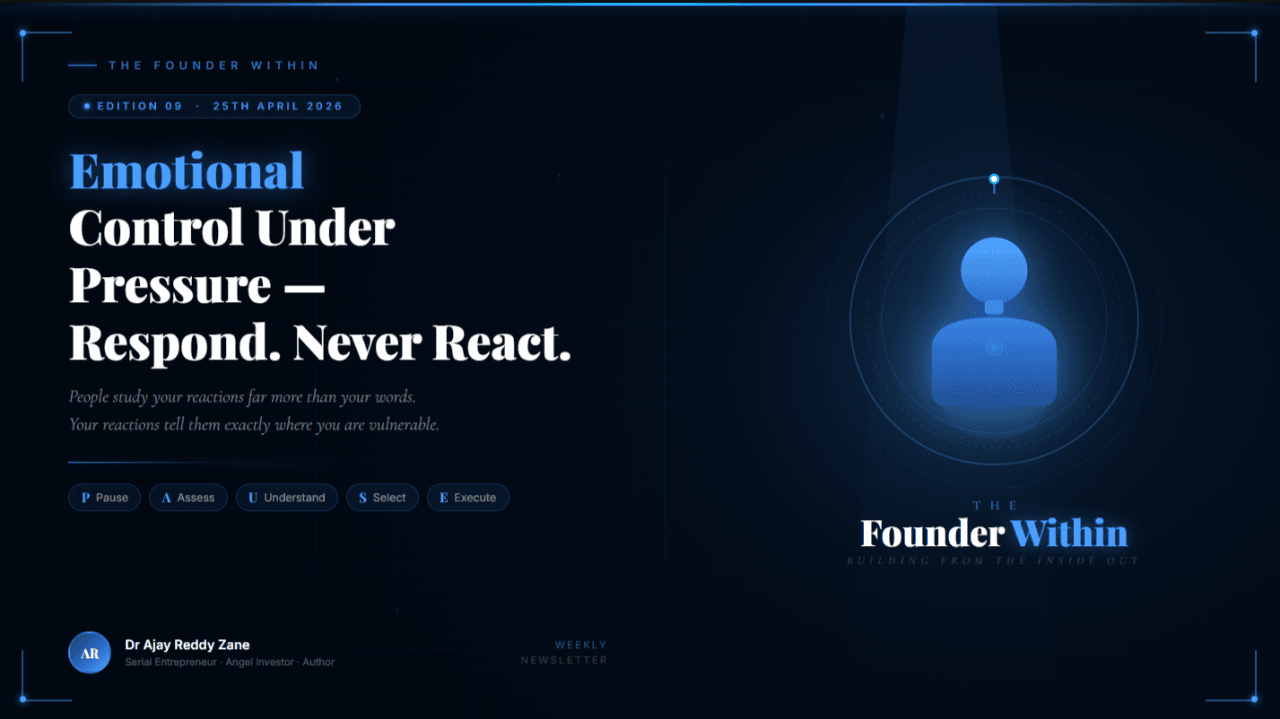
"People study your reactions far more carefully than your words. Your words tell them what you think. Your reactions tell them exactly where you are vulnerable — and precisely how to use that against you."
Every founder has a moment they wish they could take back. A reaction that came out too fast. Too loud. Too raw. A message sent in anger. A public response that made them look unstable. A confrontation that damaged a relationship they needed. A silence held too long until it became a wall. I have had all of these moments. And every single one cost me something — a deal, a relationship, a reputation, my own inner peace. Today we learn the difference between reacting and responding. It is the difference between a founder who can be played — and one who cannot.
Why Emotional Control Is The Most Underrated Business Skill
In the startup world we talk endlessly about product, market, funding and growth. We almost never talk about what happens inside the founder when the pressure becomes unbearable.
And yet — every major business failure I have witnessed or experienced had an emotional component at its root. A founder who reacted instead of responded. Who made a critical decision from anger, fear or desperation. Who let someone see exactly where they were vulnerable — and paid for it.
The Fundamental Truth
The founder who controls their emotions in pressure situations controls the outcome of almost every high-stakes interaction. The founder who cannot — hands that control to whoever is watching. Emotional control is not suppression. It is not coldness. It is the deliberate choice to respond from wisdom rather than react from wound.
The 4 Conflict Styles That Keep Costing Founders
Most founders — when I ask them how they handle conflict — describe not one consistent style but several. Different responses depending on who is involved, what the stakes are and how tired they are that day.
That inconsistency is itself the problem. Because people study your patterns. And when your reactions are unpredictable — they experiment until they find what works.
Style 1 — The Reactor
You confront immediately. Directly. Sometimes too directly. When something feels wrong — you say it. When someone crosses a boundary — you make it clear. When you are disrespected — you respond in the moment.
This style has real strengths — directness, clarity, not allowing problems to fester. But when it activates from a triggered state rather than a grounded one — it becomes aggression. And aggression gives others the narrative advantage. Suddenly you are the problem.
The Hidden Cost
People learn to provoke you. They know that a certain type of trigger will produce a certain type of reaction. And they use your predictable reactions to make you look unstable — while they appear calm and reasonable.
Style 2 — The Avoider
Conflict feels costly. Uncomfortable. Potentially destructive to relationships you value. So you avoid it. You give people the benefit of the doubt. You hope the problem resolves itself. You prioritise harmony over truth.
This style also has strengths — you preserve relationships, you give people space to self-correct. But when a real problem is being avoided — it does not disappear. It grows. And by the time you finally address it — you are dealing with a crisis rather than a concern.
The Hidden Cost
People learn they can take liberties with you. Small transgressions go unchallenged — and gradually become larger ones. The person who might have corrected their behaviour early now has months of unchallenged patterns to defend.
Style 3 — The Suppressor
You feel everything — intensely. But you show very little. You stay calm on the outside while the inside builds pressure. You process alone. You hold in the frustration, the anger, the hurt — because showing it feels like weakness or unprofessionalism.
This style protects your image in the short term. But suppression is not processing. The emotion does not disappear — it accumulates. And eventually it finds an exit — either as a sudden explosion that seems disproportionate, or as chronic exhaustion and disengagement.
The Hidden Cost
The people around you never know where they stand. They sense something is wrong but cannot read you. This creates anxiety in your team, distance in your relationships and a reputation for being cold or unpredictable — even when you feel deeply.
Style 4 — The Oscillator
You move between all three styles depending on the day, the person and the stakes. Sometimes you confront. Sometimes you avoid. Sometimes you suppress. Your response to conflict is not driven by strategy but by whichever emotional state is most activated in that moment.
This is the most common pattern among high-functioning founders — and the most dangerous. Because it means you have no consistent conflict response system. And without a system — you are always improvising. Always reacting. Never responding.
The Hidden Cost
People cannot predict you — but they can experiment with you. They try different approaches until they find which emotional lever produces which response. And once they map your patterns — they own the dynamic.
"Reactions are owned by your triggers. Responses are owned by your wisdom. The goal is to always respond — never to merely react."
Reacting vs Responding — The Critical Distinction
Reacting
Immediate — no gap between trigger and action
Driven by emotion — anger, fear, hurt, pride
Focused on the feeling — not the outcome
Often regretted later
Reveals your vulnerabilities
Hands control to the other person
Responding
Deliberate — there is a gap. A pause. A choice.
Driven by intention — what outcome do I want?
Focused on the outcome — not just the feeling
Aligned with your values and strategy
Protects your position and your reputation
Keeps control with you
The Pause — Your Most Powerful Tool
Between every trigger and every reaction — there is a gap. It may be a fraction of a second. It may be large enough to feel. But it exists.
Emotional control is not about eliminating emotion. It is about expanding that gap. Making it wide enough to step into. Wide enough to ask — what response will serve me best here?
"There was a time when I would respond to a difficult message immediately. The moment I felt the emotion — I would act on it. And I would almost always regret it. Not because the emotion was wrong. But because the timing and the delivery cost me more than the original problem. The most powerful thing I ever learned was the 24-hour rule. I do not respond to anything emotionally charged in less than 24 hours. Not a message. Not a call. Not a confrontation. I feel the emotion fully — and then I respond from wisdom. That one practice has saved me more relationships, more deals and more reputation than any other single habit."
The PAUSE Framework — Emotional Control Under Pressure
P - Pause. Do not respond immediately to anything that triggers a strong emotional reaction. Create time between the stimulus and your response. Even 10 minutes changes the quality of your output dramatically.
A. Assess the actual situation. What happened? What was said or done? Separate the facts from your interpretation of the facts. Your interpretation may be accurate — but it may also be coloured by past wounds and current triggers.
U. Understand what you want. What outcome do you actually need from this situation? Not what would feel satisfying right now — but what would genuinely serve your long-term interests, relationships and mission.
S. Select your response deliberately. Having assessed the situation and clarified the outcome you want — choose your response intentionally. How will you communicate? What will you say? What will you not say? What tone will serve you best?
E. Execute from groundedness. Deliver your response from a place of calm clarity — not suppressed anger or performed calm. Genuine groundedness is felt by the person on the other side. It commands respect. Performed calm is detected — and creates distrust.
Building A Consistent Conflict Response System
The goal is not to eliminate all four conflict styles. Each has a legitimate application. The goal is to choose which style to use — rather than have the situation choose for you.
Your Conflict System
When to be direct: When the issue is significant, when delay will cause more damage, when clarity serves the relationship better than comfort.
When to pause: When you are emotionally activated, when the stakes are high, when the other person is trying to provoke a reaction.
When to let it go: When the issue is minor, when addressing it costs more than ignoring it, when the person has already self-corrected.
Never: Suppress without processing. React without a pause. Avoid a conversation that will only become harder with time.
"The calmest person in the room is almost always the most powerful. Not because they feel nothing. But because they have learned to let wisdom speak before emotion does."
Emotional control is not about becoming robotic or unfeeling. It is about becoming the kind of leader whose responses people can trust — whose words carry weight because they are chosen carefully, whose silence is not a wall but a considered pause. The founder who controls their emotions in the hardest moments — controls the outcome of those moments. And over time — controls the direction of their business, their relationships and their legacy. Feel everything. React to nothing. Respond to everything — from your best self.
"The strongest startup you will ever build is yourself." — Dr. Ajay Reddy Zane