Volume 1 · Edition 12 · 14 Oct 2026
Leading Powerfully & Influencing Ethically — Command Respect Without Demanding It.
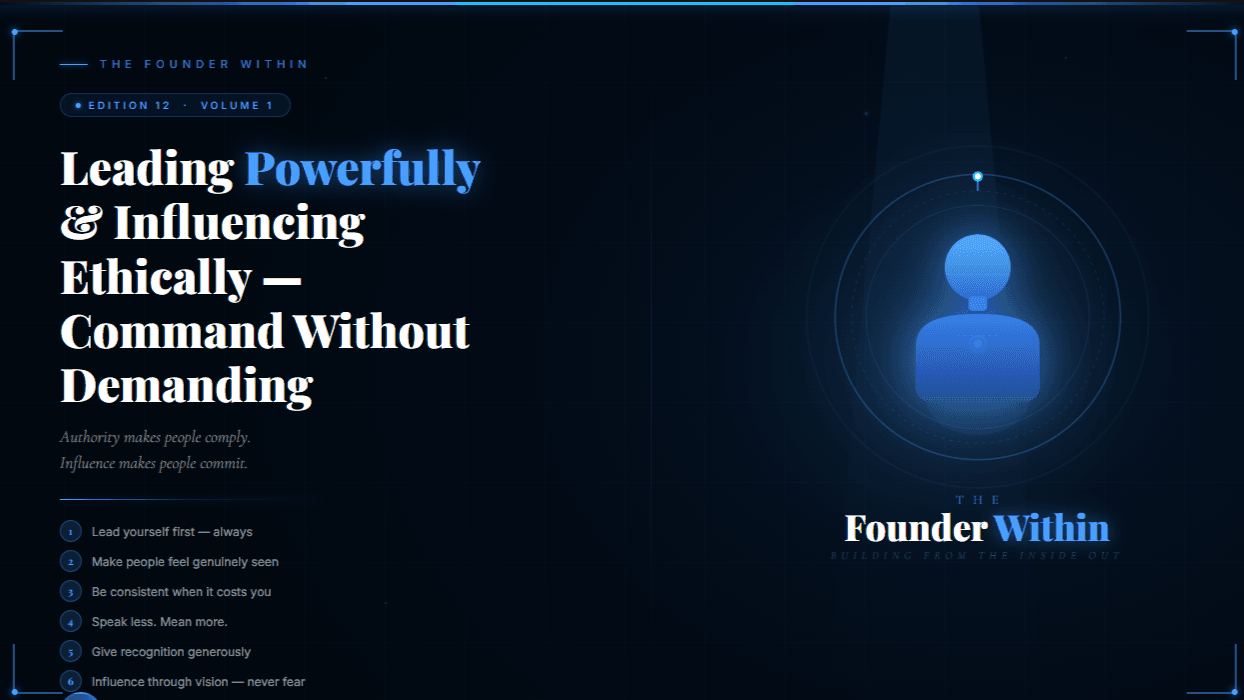
"The most powerful leaders in any room are rarely the loudest. They are the ones whose presence changes the energy before they say a single word. Who make people feel seen without trying to be seen themselves. Who influence not through force — but through the quiet, undeniable weight of who they have become."
We are near the end of this first volume of The Founder Within journey. We have done the inner work — understanding people, understanding ourselves, healing wounds, building circles, mastering emotions. Now it is time to take all of that inner depth — and channel it into the most important outer skill a founder can possess: the ability to lead powerfully and influence ethically. Not to demand respect. To earn it. Not to manipulate outcomes. To inspire them.
The Difference Between Authority And Influence
Most founders confuse authority with leadership. They believe that the title, the position, the track record — these things make people follow them. And in the short term, they sometimes do.
But authority without influence is fragile. The moment the title disappears — or the track record takes a hit — the following disappears with it. Because people were never following the person. They were following the position.
The Core Distinction
Authority is given to you by circumstance — a title, a role, a track record. Influence is earned by who you are — your character, your clarity, your consistency. Authority makes people comply. Influence makes people commit. The founder who leads powerfully does not need to assert authority. Their influence speaks before they do.
What Real Leadership Actually Looks Like
Weak Leadership
Demands respect through title and volume
Reacts emotionally under pressure
Controls through fear and dependency
Takes credit. Deflects blame.
Speaks first. Listens last.
Needs followers to feel powerful
Powerful Leadership
Commands respect through presence and character
Responds deliberately from wisdom
Inspires through vision and genuine care
Shares credit generously. Owns mistakes fully.
Listens deeply. Speaks with precision.
Is powerful enough to empower others
The 6 Principles Of Powerful Leadership
1. Lead Yourself First — Always
Every principle in this newsletter — the self-awareness, the emotional control, the healed wounds, the inner circle — is not just personal development. It is the foundation of your leadership. You cannot lead others through territory you have not navigated yourself. And people can sense — with extraordinary accuracy — whether the person leading them has done their own inner work or not.
The Practice
Before every significant leadership moment — a difficult conversation, a major decision, a high-stakes presentation — ask yourself: am I coming to this from my most grounded place? Or am I bringing unresolved emotion into the space?
2. Make People Feel Genuinely Seen
The single most underestimated leadership skill is the ability to make someone feel truly seen — not just heard, not just acknowledged, but genuinely understood at a level deeper than their words. When people feel seen by you — they trust you. When they trust you — they follow you. Not because they have to. Because they want to.
The Practice
In every conversation — ask more questions than you answer. Listen to understand rather than to respond. And reflect back what you heard — not just the words, but the meaning underneath them. This is the practice that builds extraordinary loyalty.
3. Be Consistent When It Costs You Something
Anyone can be consistent when it is comfortable. Real leadership consistency shows up in the moments when staying true to your values, your commitments and your character comes at a real personal cost. The founder who keeps their word when breaking it would be easier — who shows up for their team when they are struggling themselves — who holds their standard when compromising it would be more convenient — that founder builds the kind of trust that becomes unshakeable.
The Practice
Identify one commitment you have been inconsistent on. Not because you intended to break it — but because the pressure of building made it easy to deprioritise. Recommit to it this week. Publicly if possible. Your team is watching.
4. Speak Less. Mean More.
The most influential people in any room are rarely the ones who speak the most. They are the ones whose words carry the most weight — because they choose them carefully, deploy them deliberately and mean every single one. Over-communication dilutes influence. Under-communication with precision builds it. When you speak — people should lean in. Not because you demand it. Because they have learned that your words are always worth hearing.
The Practice
In your next meeting or event — speak 30% less than you normally would. Listen 70% more. Then say the one thing you would normally have buried in 10 minutes of talking — with full clarity and full conviction. Observe the difference in how people receive it.
5. Give Recognition Generously — Take It Rarely
Nothing builds loyalty faster than a leader who sees the contributions of the people around them and names them — publicly, specifically and genuinely. And nothing undermines trust faster than a leader who takes credit for collective achievement. The most powerful founders build ecosystems where everyone around them feels like they matter — because they do. And they demonstrate this not in speeches, but in every interaction.
The Practice
This week — recognise one person in your ecosystem who has contributed meaningfully but has not been publicly acknowledged. Do it specifically — not generic praise, but naming exactly what they did and exactly why it mattered. Then observe what that specific recognition does to the relationship.
6. Influence Through Vision — Not Pressure
The most sustainable form of influence is not persuasion or pressure — it is vision. When people can clearly see where you are going, why it matters and how they belong in that picture — they align voluntarily. They bring their best. They protect what is being built. Because they do not feel like they are working for you. They feel like they are building something together with you. That distinction — between working for and building with — is the entire difference between compliance and commitment.
The Practice
Articulate your vision — for Elfinity Universe, for The Founder Within, for whatever you are building — in one clear, emotionally resonant paragraph. Not the business description. The human mission. Why it matters. Who it serves. What it will change. Then use that paragraph as the foundation of every significant leadership communication you make.
"The founder who leads powerfully does not make people feel small so they feel big. They make people feel capable — and then build something extraordinary together."
Influencing Ethically — The Line That Cannot Be Crossed
Influence is one of the most powerful tools a leader possesses. It is also one of the most easily corrupted.
The difference between ethical influence and manipulation is not always obvious from the outside. Both involve understanding what people need, what they fear and what they want. But the intention — and the impact — are fundamentally different.
Ethical Influence vs Manipulation
Ethical influence helps people make decisions that are genuinely in their own interest. It is transparent about its intent. It respects the other person's autonomy. It makes them more capable — not more dependent. Manipulation helps the influencer at the expense of the influenced. It exploits vulnerabilities. It creates dependency deliberately. It diminishes the other person's capacity to think and decide for themselves. The test: after being influenced by you — does the person feel more capable or more dependent? That single answer tells you everything about the quality of your influence.
The Founder's Leadership Code
7 Commitments Of A Powerful Ethical Leader
1. I lead myself before I lead others. My inner clarity is the foundation of my outer leadership. I do not ask of others what I am not doing myself.
2. I make people feel genuinely seen. Every person in my ecosystem deserves to feel that their presence matters — not as a performance, but as a reality I create through how I listen and how I respond.
3. I am consistent when it costs me something. My word is my most valuable asset. I protect it with the same care I protect my business.
4. I speak with precision and purpose. Every word I use publicly is chosen. I do not speak to fill silence. I speak to add meaning.
5. I give recognition generously. The success of the people around me is not a threat to mine. It is the proof that my leadership is working.
6. I influence through vision — never through fear or dependency. My goal is always to make the people around me more capable — not more reliant on me.
7. I hold the line on ethics absolutely. There is no business outcome that justifies manipulation, deception or the exploitation of trust. None. Ever.
"The Elfinity Group is not just a business ecosystem. It is a leadership laboratory. Every event I run, every founder I mentor, every edition of this newsletter — is a practice in leading powerfully and influencing ethically. I have not always done this perfectly. But the commitment to doing it — to building something where people feel genuinely seen, genuinely supported and genuinely capable — that commitment has never wavered. And it is the one thing I am most proud of in everything I have built."
"You were not born a leader. You become one — every day — through the choices you make when it would be easier to choose differently."
Leadership is not a destination. It is a daily practice. A daily choice to show up with integrity when compromise would be easier. To listen when speaking would feel better. To give recognition when taking it would be more satisfying. To build others up when tearing down would be more expedient. The founder who leads this way — from the inside out, with power grounded in character and influence rooted in ethics — builds something that lasts far beyond any single product, company or ecosystem. They build a legacy. And that legacy — more than any revenue milestone or market position — is what endures.
"The strongest startup you will ever build is yourself." — Dr. Ajay Reddy Zane