16 Oct 2026
Before You Raise: Are You Ready for Capital?
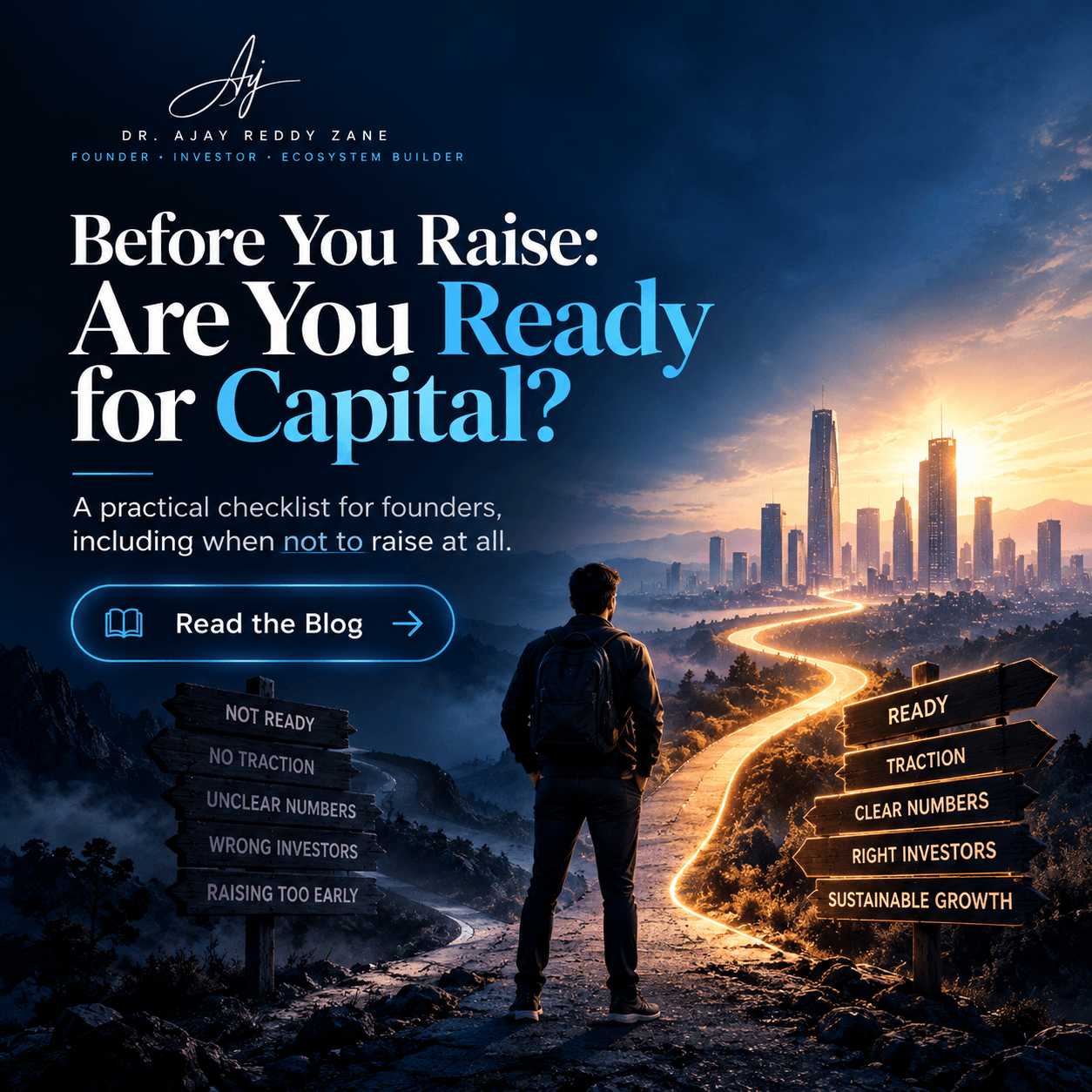
A practical checklist for founders, including when not to raise at all
Every week, a founder tells me they are "ready to raise."
Most of them are not. Their idea isn't the problem, and neither is their ambition. They are confusing wanting capital with being ready for it.
Across years of running the Investors' Room and our pitch events, I have watched hundreds of founders walk up to investors. The ones who walk away with a cheque are rarely the ones with the flashiest deck. They are the ones who did the unglamorous work before they ever asked for money.
This is that work.
First, understand what capital actually is
Capital is not validation. It is not a prize for having a good idea.
Capital is fuel. Fuel only helps if you already have an engine that runs. Pour fuel into an engine that doesn't work and you don't go faster. You just burn more, more expensively.
So before you ask "How much should I raise?", ask a harder question: "Is there an engine here that money will accelerate?"
If you can honestly answer yes, use the checklist below. If you can't, skip to the section on when not to raise. It may save you a year.
The readiness checklist
1. Traction: proof that someone wants this
Investors fund evidence, not enthusiasm. Traction looks different at each stage:
Pre-revenue: real users, a waitlist that converts, pilots with named customers, letters of intent.
Early revenue: paying customers who come back, and month-on-month growth you can show and explain.
Growth stage: unit economics that improve as you scale.
Ask yourself: If I removed my own belief from this pitch, what proof would be left on the table? Whatever is left is your traction.
Red flag: "Everyone I've shown it to loves it." Friends and family are not a market.
2. Clean financials: numbers you can defend
You don't need a CFO at the seed stage. You do need to know your numbers without opening a spreadsheet:
Your monthly burn
Your runway in months
Your revenue, and how it is made up
Your customer acquisition cost and what a customer is worth to you, even if these are early estimates
Clean books: separate business and personal accounts, GST and compliance in order
Nothing ends an investor conversation faster than a founder who hesitates on their own burn rate. If you don't know your numbers, the investor assumes you don't know your business.
3. A cap table that makes sense
Your cap table, the record of who owns what in your company, tells an investor a story before you say a word.
Watch for these warning signs:
Founders who own too little, too early. If founders have given away large chunks before a real round, investors worry about motivation and future dilution.
Dead equity. Large stakes held by people no longer involved, such as an early co-founder who left or an advisor who did nothing.
Messy informal promises. "I told him he'd get 5% someday" is not a cap table. It is a future legal problem.
Clean it up before you raise. Document every agreement, and set up vesting for co-founders. An investor will find every crack during due diligence, so find them first.
4. A clear use of funds
"We'll use the money to grow" is not an answer.
A strong use of funds says exactly where the money goes and what it buys:
How much goes to hiring, which roles, and why now
How much goes to customer acquisition, and the expected return
How much goes to product, and which milestones it unlocks
How many months of runway this round gives you
The milestone you will hit before you need the next round
That last point matters most. Every round should buy you a set of proof points that makes the next round easier. If you can't say what this money will prove, you're not ready to ask for it.
5. The right ask for your stage
Raising too much is as dangerous as raising too little. Too little and you run out before you hit your milestones. Too much at the wrong valuation and you set a bar your next round can't clear.
Your ask should come from your use of funds, not from what another startup raised.
6. The right investors, not just any investors
Not every investor is your investor. Before you pitch, check:
Do they invest at your stage?
Do they invest in your sector?
What have they backed before, and do they bring more than money?
Have you spoken to founders they've funded?
A wrong-fit investor wastes your time at best. At worst, they sit on your cap table for a decade pulling in the wrong direction.
7. A pitch that is clear, compelling and concise
Your pitch should answer, in this order: What problem? For whom? Why now? Why you? What proof? What do you need, and what will it achieve?
If someone outside your industry can't explain your business back to you after two minutes, your pitch isn't ready.
When NOT to raise
This is the part most people skip, and it is the most important.
Don't raise if you haven't found product-market fit and money won't help you find it. Capital scales what is working. It rarely fixes what isn't.
Don't raise to avoid a hard decision. If the real problem is the model, the team or the market, more money just delays the conversation and makes it more expensive.
Don't raise because everyone else is. Funding announcements are visible. The companies that died after raising too early mostly aren't.
Don't raise if you can grow on revenue. Every rupee you raise costs you ownership and adds expectations. If customers can fund your growth, that is the most founder-friendly capital in the world.
Don't raise if your co-founder alignment is shaky. Investors back teams. If your foundation is cracked, capital will widen the cracks.
Sometimes the most strategic thing a founder can do is wait six months, hit two more milestones, and walk into the room from a position of strength instead of need.
The real test
Here is the simplest test I know.
If an investor said "yes" tomorrow and wired the money on Monday, would you know exactly what to do with it on Tuesday?
If yes, you are close. If you hesitated, that hesitation is your homework.
Being ready for capital is not about looking ready. It is about being ready, so that when the money arrives it accelerates something real.
Preparing to raise and want an honest review before you walk into the room? My Investor Readiness Guidance & Review covers your pitch, deck, numbers, ask and investor targeting, so you know exactly where you stand. Book a session →